
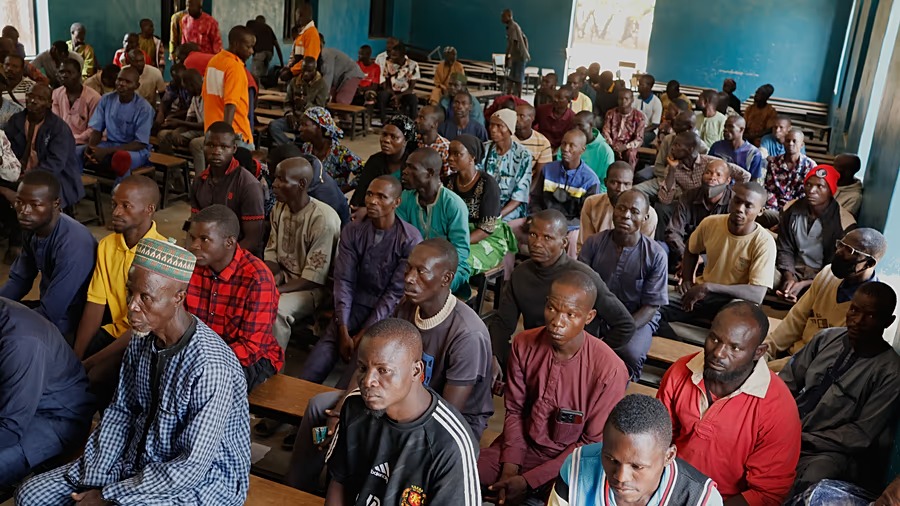
Two weeks after gunmen stormed a Catholic boarding school in northern Nigeria and abducted hundreds of children, the nation remains gripped by anguish, uncertainty and intensifying public outrage. For the parents of the missing students, the silence has become excruciating—an interminable wait punctuated only by rumours, official platitudes and flickers of false hope.
The attack, which occurred in the early hours of November 21, saw armed men descend on the school compound with ruthless efficiency. More than 300 students and staff were taken in the raid, according to school officials, making it one of the deadliest and most brazen mass kidnappings in the country in recent years. Although 50 children managed to escape, more than 250 remain in captivity, their whereabouts unknown, and their fate left to conjecture.
For many families, the ordeal has been compounded by a growing sense of abandonment. Parents who gather daily at the school gates speak of a government response they view as lethargic and insufficiently urgent. “If these were the children of the powerful, would they still be missing?” one distraught father asked, his voice cracking under the strain of grief and indignation. Across the community, there is a prevailing belief that authorities are failing to treat the crisis as the full-blown emergency it is.
The kidnapping is an unsettling reminder of the 2014 abduction of 276 schoolgirls from Chibok by Boko Haram, a tragedy that captured global attention and became emblematic of the escalating insecurity in northern Nigeria. Though the country vowed “never again,” many Nigerians now fear they are witnessing a dangerous recurrence of the very horrors that Chibok was supposed to prevent. Human rights groups say the rise in kidnappings is fuelled by a combination of weak law enforcement, porous borders and the growing confidence of criminal gangs who see school raids as lucrative ventures.
Security forces insist they are pursuing “decisive rescue operations,” but similar assurances in past cases have rarely translated into timely or successful recoveries. The government has neither disclosed the location of the abductors nor given a timeline for the children’s release. The lack of transparency, critics say, has deepened mistrust and fuelled accusations of bureaucratic inertia. Many parents accuse the authorities of withholding information or downplaying the severity of the crisis.
President Bola Ahmed Tinubu, in a televised address, declared a security emergency and ordered the immediate recruitment of additional security personnel. He vowed to “end the scourge of mass abductions,” announcing that new counter-kidnapping units would be deployed to high-risk communities. But such promises are familiar. Since 2014, successive governments have issued similar declarations, while mass kidnappings have continued to proliferate with chilling regularity.
Nigeria now faces critical security threats from an array of armed groups: extremist factions, rural bandits, rogue militias and criminal networks that specialise in kidnap-for-ransom schemes. Analysts say many of these groups exploit the state’s limited capacity to secure remote communities, carrying out raids with impunity and retreating into difficult terrain where security forces struggle to pursue them.
According to a recent national security tally, at least a dozen mass abductions of school students have occurred since the Chibok attack. In total, 1,799 students have been kidnapped in the last decade—a figure that experts believe may be an underestimate due to underreporting and the lack of comprehensive national data. While some victims are eventually released—often after hefty ransom payments—others remain missing for years, their disappearances shrouded in painful ambiguity.
Beyond the statistics, the social toll is immense. Schools in several northern states have been forced to shut down or relocate, exacerbating educational disparities in a region already facing chronic underinvestment. Children who witness or survive such attacks often suffer long-term psychological trauma. Parents, many of whom sold property or borrowed money to send their children to boarding school, now question whether education itself has become a perilous pursuit.
As the crisis stretches into its third week, the mood across Nigeria oscillates between despair and defiance. Civil society groups are calling for nationwide protests, while religious leaders have urged political authorities to “restore the sanctity of schools as safe spaces.” International organisations have also expressed alarm, warning that Nigeria’s education system cannot withstand continued assaults on its institutions.
Yet for the families whose children remain captive, broader policy debates offer little comfort. What they want—what they plead for—is immediate action. Each dawn brings renewed anguish, each sunset the fading hope that the next knock on their door will bring news of a rescue. Two weeks on, Nigeria waits. But no one waits more agonisingly than the parents whose children are somewhere in the dark, still missing, still beyond reach.