

Justice Emeka Nwite of the Federal High Court, sitting in Maitama, Abuja, on Friday, January 2, 2026, further remanded former Attorney General of the Federation and Minister of Justice, Abubakar Malami, SAN, his son, Abubakar Abdulaziz Malami, and his wife, Hajia Bashir Asabe, in the Kuje Correctional Centre, Abuja, till January 7, 2026, for ruling on their bail applications.
The Economic and Financial Crimes Commission, EFCC, is prosecuting the defendants over alleged money laundering offences to the tune of N8,713,923,759.49 (Eight Billion, Seven Hundred and Thirteen Million, Nine Hundred and Twenty-Three Thousand, Seven Hundred and Fifty-Nine Naira, Forty-Nine Kobo).
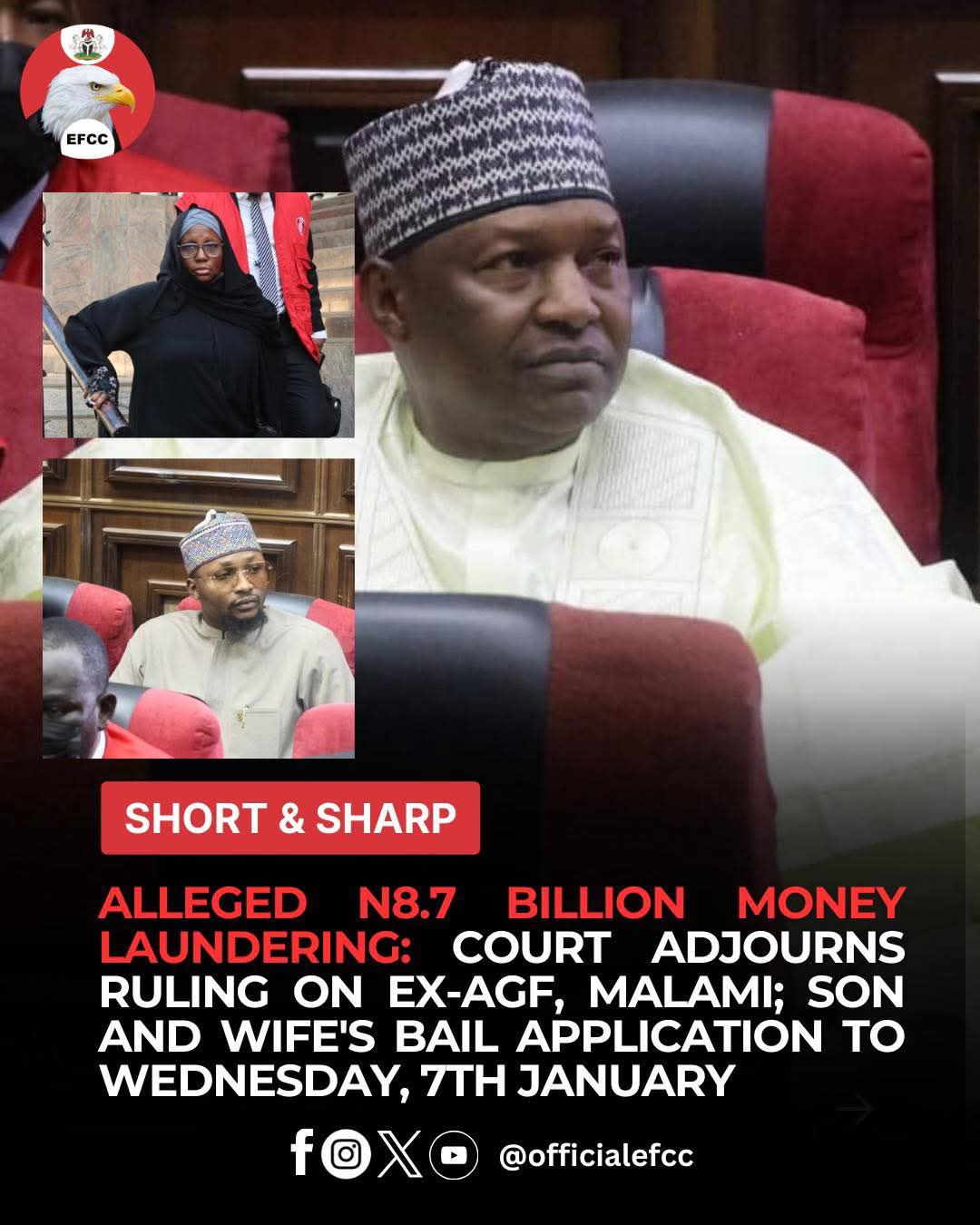

They were docked on a 16-count charge bordering on conspiracy, procuring, disguising, concealing and laundering proceeds of unlawful activities, contrary to the provisions of the Money Laundering (Prevention and Prohibition) Act, 2022.
At the resumed hearing on Friday, prosecution counsel, Ekele Iheanacho, SAN, informed the court that the matter was slated for the hearing of the bail applications filed by the defendants.
Responding, counsel to the defendants , J.B Daudu SAN, told the court that prosecution just served them with a counter affidavit in the court and therefore needed to go through it and respond accordingly.
After going through it, Daudu filed a counter affidavit of about 28 to 30 paragraphs challenging why the defendants should no longer be in detention.
Meanwhile, Iheanacho told the court that they had just been served with a counter affidavit and sought time to study the processes.
“We were served with a counter affidavit and sought time to go through the processes, my lord. We have now been served with a further affidavit, each of them with about 28 to 30 paragraphs, as well as a reply on points of law. I have not gone through what they have filed and may need time to do so,” he said.
Responding, counsel to the defendants argued: “My lord, the matter was adjourned to today and there is a working day in between. I don’t know why they didn’t serve us. There’s no point for the prosecution to be prolonging the detention. They have no right to reply again. If he needs 15 to 20 minutes, the court can grant him.” He added that professional courtesy should prevail, stressing his readiness to proceed.
In his response, Iheanacho pointed out that, “My lord, as much as it is not our intention for the defendants to stay long in incarceration without basis, and as a senior member of the Bar, I have tremendous respect for my learned friend. However, I have just been served with three processes of about 28 to 30 paragraphs. It is better to make haste slowly.”
Following exchanges between counsel and with no objection, the court struck out an application and granted another upon defence counsel’s prayer.
Moving the bail applications, Daudu urged the court to admit the 1st, 2nd and 3rd defendants to bail, praying that the first defendant be admitted on self-recognisance, while the second and third defendants be granted bail on liberal terms.
“My lord, as it relates to the first defendant, the immediate past Attorney General of the Federation and Minister of Justice, the application is supported by a 36-paragraph affidavit deposed to by his son, Nuzain Malami, on December 29, 2025, with six annexures marked Exhibits A1, B, C and E, and a written address,” he said.
He further explained that the application for the second defendant was supported by a 28-paragraph affidavit deposed to by her daughter, Farida Abdullahi Usman, with Exhibits A and B attached, alongside a written address dated December 29, 2025. The third defendant’s application, he added, was supported by a 39-paragraph affidavit deposed to by his brother, Nuzain Malami.
Daudu argued that the offences were bailable, and that the defendants were presumed innocent until proven guilty. He dismissed allegations of interference with witnesses as speculative, pointing out that the defendants had earlier been granted administrative bail by the EFCC.
“It is contradictory for a party that granted administrative bail to now argue otherwise,” he submitted, urging the court to exercise its discretion in favour of the defendants.
Opposing the applications, Ihenacho told the court that the EFCC filed three separate counter affidavits against the defendants on January 2, 2026, deposed to by Adebayo Daniel, an operative of the Commission, and supported by written addresses.
“My noble lord, the averments in the counter affidavits, particularly on suborning of witnesses and interference with evidence by the first and second defendants, have not been controverted,” he said, relying on judicial authorities to argue that undisputed facts are deemed admitted.
He contended that interference with witnesses strikes at the root of fair trial and urged the court to consider relevant provisions of the Administration of Criminal Justice Act (ACJA) in refusing bail.
Addressing the issue of earlier administrative bail, the prosecution argued that pre-trial bail during investigation differs from bail during trial after charges have been filed.
“Presumption of innocence does not give an automatic ticket to bail,” the prosecution added, urging the court to refuse the applications.
In his brief remarks, Justice Nwite noted the workload before the court during the vacation period but assured that justice would be served promptly.
“I have many high-profile cases during this vacation period, but justice will be served in the shortest possible time,” he said.
He thereafter adjourned till January 7, 2026, for ruling on the bail applications.