
Djibouti’s long-serving president, Ismail Omar Guelleh, has secured a sixth term in office with an overwhelming 97.8 per cent of the vote, according to official results announced on Saturday, further entrenching his near three-decade grip on power in the strategically vital Horn of Africa state.
The 78-year-old leader’s landslide victory over his only challenger, Mohamed Farah Samatar, underscores both the dominance of the ruling establishment and the limited space afforded to meaningful political opposition in the small but geopolitically significant nation. Samatar, a relatively obscure political figure, garnered just 2.2 per cent of the vote, according to figures released by the interior ministry.
Guelleh had declared himself “re-elected” on social media even before the official tally was confirmed, citing early results that showed him commanding a decisive lead. Few observers within Djibouti or abroad were surprised by the outcome, which mirrors previous elections widely criticised by opposition groups and international observers for lacking competitiveness.
Having first assumed office in 1999, Guelleh is now entering his 27th year in power. Over that period, he has cultivated a reputation as a shrewd السياسي operator who has leveraged Djibouti’s strategic location at the crossroads of Africa and the Middle East to secure both economic rents and international relevance.
Situated along the Bab el-Mandeb Strait — one of the world’s busiest shipping lanes — Djibouti occupies a uniquely valuable position in global trade and security. Despite its modest size of just 23,000 square kilometres and a population of around one million, the country hosts an array of foreign military installations, including bases operated by France, the United States, China, Japan and Italy. These facilities provide Djibouti with substantial revenues, while also cementing its role as a critical hub for counterterrorism, maritime security and regional stability operations.
Under Guelleh’s leadership, the state has capitalised on this positioning, attracting foreign investment and forging strategic partnerships that have bolstered government finances. However, critics argue that the benefits of this geopolitical windfall have not been equitably distributed among the population, with high levels of unemployment — particularly among young people — and persistent concerns over governance and political freedoms.
Friday’s election unfolded amid tight security, though turnout appeared subdued and the atmosphere largely devoid of suspense. In the capital, Djibouti City, campaign posters bearing Guelleh’s image dominated the streets, reflecting the imbalance in visibility and resources between the incumbent and his challenger.
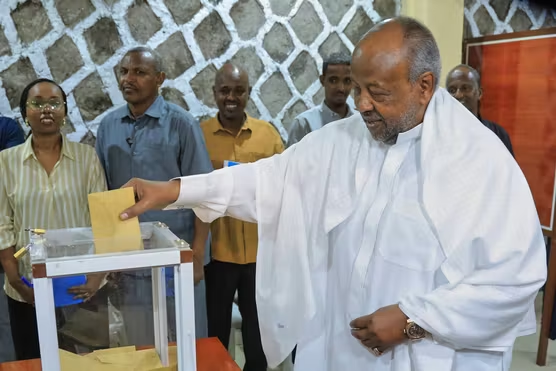
Guelleh, often referred to by his initials “IOG”, cast his vote at City Hall alongside his wife shortly before midday. Addressing reporters, he expressed confidence in the outcome, stating: “By the grace of God, we have arrived here, and we hope that this will end in victory.”
Samatar, leader of the small Unified Democratic Centre (CDU), voted earlier in the day. His campaign struggled to gain traction, hampered by limited exposure and organisational capacity. State media coverage highlighted the disparity: while Guelleh’s rallies drew thousands of supporters, one broadcast of a Samatar campaign event showed only a few dozen attendees.
The CDU itself holds no seats in parliament, underscoring the broader marginalisation of opposition parties within Djibouti’s political system. Previous elections have been marked by boycotts from major opposition coalitions, a pattern that continued in 2021 when Guelleh won more than 97 per cent of the vote in a contest widely dismissed as uncompetitive.
This year’s poll was initially expected to mark a transition. Guelleh had earlier indicated that he would step down, raising hopes among some observers that Djibouti might witness its first transfer of power since independence from France in 1977. However, those expectations were dashed following a constitutional amendment passed in November that removed the upper age limit of 75 for presidential candidates, effectively clearing the way for Guelleh to run again.
The move drew criticism from opposition figures and civil society groups, who argued that it further weakened democratic safeguards and reinforced an already entrenched system of rule. Government supporters, by contrast, defended the amendment as a necessary adjustment that allows experienced leadership to continue guiding the country through a complex regional environment.
Indeed, Djibouti’s strategic importance has only grown in recent years, amid heightened geopolitical competition in the Red Sea corridor and the broader Horn of Africa. The presence of multiple foreign powers within its borders has transformed the country into a focal point for international rivalry, while also providing the government with leverage in its diplomatic relations.
Yet this prominence has not insulated Guelleh’s administration from scrutiny. Human rights organisations have repeatedly raised concerns about restrictions on press freedom, limits on political participation and the treatment of dissenting voices. Independent media outlets are scarce, and opposition figures have often faced legal and administrative hurdles in organising campaigns or reaching voters.
For many ordinary citizens, however, stability remains a key consideration. In a region frequently beset by conflict and political upheaval, Djibouti has maintained a degree of continuity that some view as a virtue, even if it comes at the cost of political pluralism.
“I’m going to vote for Ismail Omar Guelleh because he has a good programme for young people,” said Deka Aden Mohamed, a 38-year-old voter, reflecting a sentiment that appears to resonate among sections of the electorate. “I don’t even know what his opponent looks like,” she added, highlighting the limited visibility of alternative candidates.
Polling on Friday was not without logistical challenges. Some stations opened late, prompting officials to extend voting hours by an additional hour in certain areas. Nevertheless, these delays did little to alter the broader trajectory of the election, which was widely regarded as a foregone conclusion.
As Guelleh embarks on yet another term, questions are likely to persist about the future of governance in Djibouti. With constitutional barriers to prolonged rule now removed, there is little immediate indication of a transition on the horizon.
For international partners, the result presents a familiar dilemma: balancing strategic interests in a critical region with concerns over democratic standards. Djibouti’s role as a host to key military bases ensures its continued relevance on the global stage, even as its domestic political landscape remains tightly controlled.
Whether Guelleh’s extended tenure will bring further economic development and stability, or deepen existing inequalities and political constraints, remains to be seen. What is clear, however, is that Djibouti’s veteran leader has once again consolidated his hold on power, reaffirming a political order that shows few signs of imminent change.