
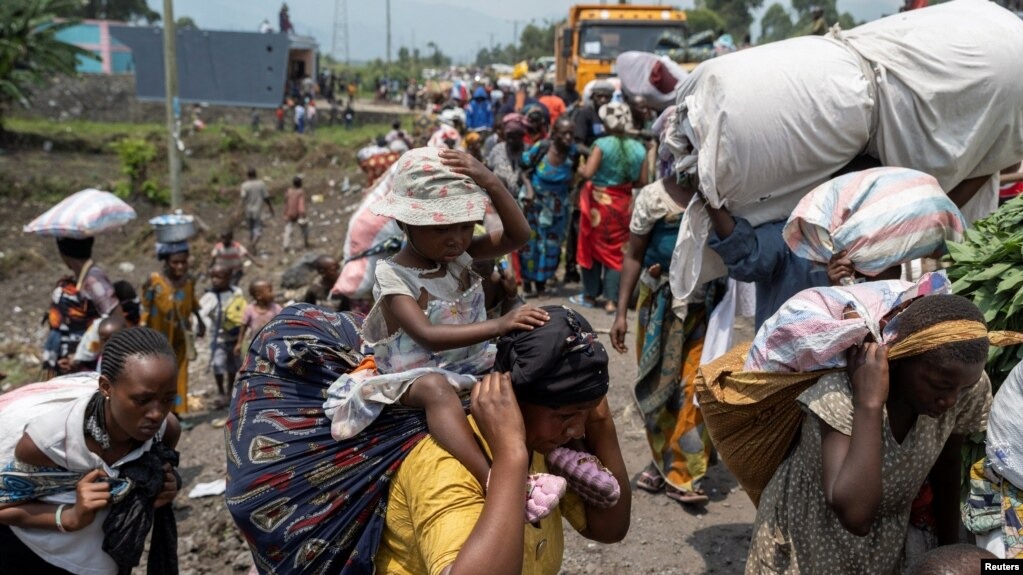
Eastern Democratic Republic of the Congo is once again slipping into chaos, as ferocious clashes between government forces and the rebel M23 group force thousands to flee their homes. In South Kivu, families are abandoning villages, carrying whatever they can salvage, in a desperate scramble for safety along the Katogota–Luvungi–Kamanyola corridor.
The violence erupted earlier in the week and escalated dramatically on Saturday, when bombs and artillery shattered the quiet of rural communities. Civilians, fearing for their lives, fled from Luvungi and nearby villages — making for Uvira and other towns further south — in a mass exodus triggered by indiscriminate shelling.
“We are walking to Uvira,” said Aline Sambuka, who fled with her children. “May the authorities help put an end to this war! We want to go back home and live like everyone else. Many people have died because of the bombings. I survived with my children.”
Another resident, displaced from his home and speaking from the roadside, captured the terror in plain terms: “The M23 and the Congolese army are dropping many bombs on Luvungi,” he said. “Since the day before yesterday, they have caused numerous deaths. Yesterday, people were killed in my neighbourhood, which is why we decided to flee today.”
Local reports estimate that at least twenty civilians were killed in the latest round of fighting across the Ruzizi plain — women and children among them — a grim reminder of the human cost being paid for a conflict that has haunted the region for years. Towns such as Katogota and Kamanyola, once quiet rural settlements, are now scarred battle zones.
Saturday morning saw clashes once more erupt around Luvungi, and aid workers have warned that the scale of displacement is rising by the hour. Long columns of people — some on foot, others perched precariously atop overloaded motorbikes or trucks — are moving south under the weight of fear and urgency.
The new wave of violence shattered whatever hope remained following a ceasefire signed in Washington just days earlier by the governments of the Democratic Republic of the Congo and neighbouring Rwanda. The accord had raised hopes for a de-escalation of the long-running war in the east. But within hours of the agreement being proclaimed, shelling resumed. Accusations flew in every direction: both M23 and the Congolese armed forces accused the other of breaking the truce. Civilians suffered the consequences.
This renewed fighting is part of a broader rebel offensive that began in 2022, which has seen M23 seize large swathes of territory — including key towns and mineral-rich areas — prompting a humanitarian crisis that has displaced millions. The rebels continue to claim their fight is to protect the rights of marginalised communities long neglected by Kinshasa, though critics argue the resurgence is driven by a desire to control mineral wealth — cobalt, coltan and other resources essential to global electronics and battery industries.
Over the past months, the conflict has exacted a deadly toll. Many civilians — women, children, elders — have been caught in the crossfire. Entire communities have been uprooted. For the thousands who fled on Saturday, the Washington agreement is already reduced to ashes on the ground — a fragile peace torn apart by the first bombs.
The international community has called for urgent intervention to prevent further civilian suffering. But without swift mediation and genuine guarantees, many fear that the entire region could spiral further — with ordinary people once again paying the highest price for a war that is all too familiar.