

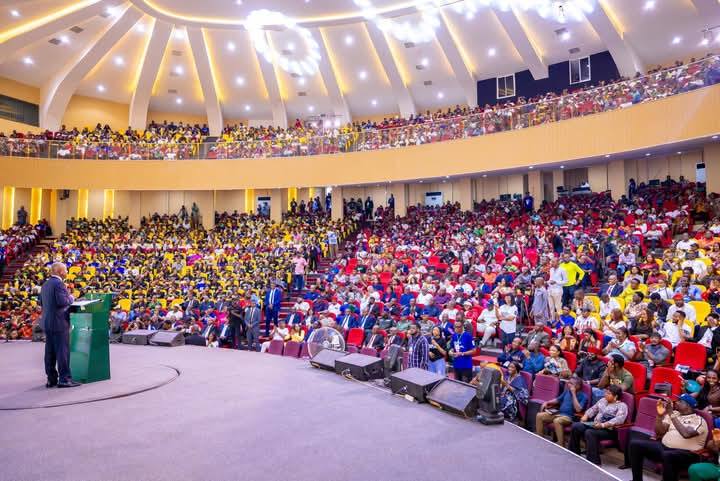
Enugu’s skyline sits comfortably with Governor Peter Mbah’s polished glass of the new Enugu International Conference Centre shimmering beneath the Nigerian sun. The road networks, the shining revamped Enugu Presidential Hotel, the nearly completed 5‑Star Enugu International Conference Centre Hotel, the on-going construction of 300-bed Enugu International Hospital, all signal a city reaching decisively for a different tomorrow. It is here, in the heart of Southeast Nigeria’s storied “Coal City,” that one of the continent’s most ambitious technology gatherings — the Enugu Tech Festival (ETF) 2026 — is preparing to take centre stage.
Building on the success of its inaugural edition, the 2026 festival promises a richer, more expansive blend of ideas, investors, innovators and youthful ambition. Over four days, from February 24 to 27, an estimated 50,000 participants are expected to converge on Enugu — from homegrown coders and startup founders to foreign technology executives and policy thinkers. Together, they will explore a bold proposition: that a city once defined by coal can reinvent itself as a digital powerhouse, and in doing so, reshape the geography of African innovation.

The theme for the 2026 edition — “Coal to Code: Energy in New Form” — is more than a clever slogan. It embodies a philosophy of reinvention that defines Enugu’s current trajectory — “Tomorrow Is Here” — a bold and disruptive vision championed by Governor Peter Mbah as the State pivots to a new era of growth fuelled by innovation.
For Governor Mbah’s administration, the festival is not a ceremonial showcase but a pillar of a broader economic reorientation. Under the stewardship of the state’s Commissioner for Innovation, Science and Technology, Dr Prince Lawrence Ezeh, Enugu has placed digital infrastructure, skills development and private-sector partnership at the centre of its development agenda. “What is expected from the Enugu Tech Festival 2026,” Dr Ezeh explains, “is that our young people who would be coming in for the festival should look out for very important engagement from the industry experts, to make direct contact with tech investors. In case you have any product you are working on, or any tech you are already building on, this is the right opportunity.”
That sense of urgency reflects a broader understanding of how technology ecosystems mature. Ideas alone are insufficient; they must be refined, tested and financed. ETF 2026 is designed as a bridge between creativity and commercialisation, offering young innovators a rare chance to engage directly with those who can help scale their work. According to Dr Ezeh, technology experts from the United States, Canada and other global innovation centres will be in Enugu not merely as speakers, but as collaborators. “They are going to be here to help harness and provide accuracy to any tech product by our young tech inventors,” he says, “and bring it to a level where it will be commercially viable.”
The first edition of the Enugu Tech Festival, held last year at the expansive Enugu International Conference Centre, drew nearly 30,000 attendees from across Nigeria. Developers, designers, entrepreneurs and digital creatives filled the halls, signalling an appetite that exceeded even the organisers’ expectations. That inaugural gathering established Enugu not as a peripheral observer of Africa’s tech conversation, but as an active contributor.
ETF 2026 seeks to build on that foundation, both in size and in substance. While keynote addresses will feature prominently, the programme places equal weight on workshops, hackathons and hands-on labs. Sessions will cover artificial intelligence, blockchain applications, smart-city infrastructure, nanotechnology, biotechnology and green technology solutions — fields increasingly shaping global economic competitiveness.
“Technology is the wave of the future,” says Professor Chinedu Nebo, former Minister of Power and a respected voice in Nigeria’s policy and academic circles. “There’s nanotechnology and biotechnology and many more. And all of these are driven by innovation.” His words capture the spirit underpinning ETF 2026: a recognition that the next phase of development will be determined less by natural resources than by intellectual capital.
It is precisely for this reason that Professor Nebo joined tens of other African change-makers to endorse the Enugu Tech Festival as a timely and necessary platform. In his view, spaces that nurture innovation are no longer optional luxuries; they are essential infrastructure. ETF 2026, he argues, is designed to expose young people to the skills, ideas and collaborations that will define tomorrow’s economy. It is about preparing minds, not just showcasing gadgets.
Beyond the main conference, the festival incorporates outreach programmes targeting secondary schools, polytechnics and universities across Enugu State. The aim is to seed long-term talent pipelines by introducing students early to careers in software development, cloud computing, artificial intelligence and digital product design. In a region where traditional professions have long dominated aspirations, this exposure represents a quiet but significant cultural shift.


Unlike many technology events that are heavy on speeches but light on outcomes, Enugu’s approach is deliberately action-oriented. Hackathons will challenge participants to solve real-world problems under time constraints, while coding labs will offer guided instruction in emerging tools and languages. Mentorship sessions will focus on commercialising innovations, navigating regulatory environments and accessing global markets — topics often overlooked in technical training.
A highlight of the 2026 programme is the “Inventors Deal Room,” a bespoke investment and collaboration space designed to accelerate startups from concept to scale. Here, founders can pitch directly to venture capital firms, angel investors and corporate partners in a controlled, outcome-driven environment. The logic is simple: founders need more than applause; they need capital, partnerships and guidance. By concentrating these resources in one place, Enugu hopes to shorten the distance between ambition and achievement.
A software engineer from Lagos preparing to attend ETF 2026 puts it plainly: “This is where dreams meet dollars. If your product is real, this festival could be the moment that defines your future.” His words echo a sentiment shared by many in the ecosystem — that opportunity is increasingly mobile, and that the right platform can change trajectories.
As February approaches, anticipation around the festival is building. Hotel bookings are filling, programme schedules are being finalised and online conversations are gaining momentum. For four days, Enugu will, once again, place itself at the centre of Africa’s technology discourse, inviting investors, innovators and policymakers to reconsider where innovation can flourish.
When the lights dim and the banners come down, the true measure of ETF 2026 will not be attendance figures or social media impressions. It will be found in startups funded, partnerships forged, skills acquired and ambitions sharpened. If the festival delivers on its promise, Enugu’s transformation from coal town to code capital will move from aspiration to inevitability.
As screens glow and keyboards clatter across the Coal City, one thing is becoming increasingly clear: Africa’s technological future is no longer confined to its coastlines. It winds inland, through the hills of southeastern Nigeria, where new veins of innovation — powered by code.