
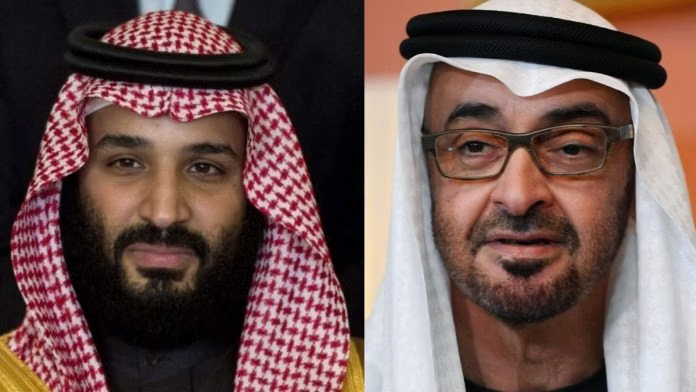
For much of the past half-century, Saudi Arabia and the United Arab Emirates were regarded as natural allies — conservative monarchies bound by geography, shared threats, tribal connections and a common interest in preserving regional stability. Saudi Arabia, long the Arab world’s political and religious heavyweight, and the UAE, an increasingly confident economic and diplomatic actor, often acted in lockstep on regional issues. Their partnership was widely viewed as one of the strongest relationships in the Middle East.
That image, however, has steadily evolved. While Riyadh and Abu Dhabi remain partners on paper, their relationship has shifted from one of hierarchy and coordination to one marked by competition, strategic divergence and quiet rivalry. Today, they cooperate when interests align, but increasingly pursue parallel — and sometimes conflicting — visions of regional leadership.
The foundations of the relationship predate the formation of the UAE in 1971. Tribal and familial ties connected ruling families across the Arabian Peninsula, and Saudi Arabia played a supportive role in the emergence of the Emirates as a unified state under Sheikh Zayed bin Sultan Al Nahyan. In the decades that followed, the balance of power was unmistakable. Saudi Arabia dominated economically, militarily and religiously, while the UAE focused inward on federation-building and economic development.
During this period, the UAE largely aligned its foreign policy with Riyadh’s positions, particularly on Iran, Arab nationalism and internal Gulf security. The establishment of the Gulf Cooperation Council in 1981 formalized this alignment. Created to safeguard Gulf monarchies from external threats — especially revolutionary Iran — the GCC institutionalized Saudi leadership and UAE partnership. For years, Abu Dhabi deferred to Riyadh on major strategic decisions, and the relationship was characterized by trust and predictability.
The Arab Spring uprisings of 2011 initially strengthened the alliance. Both governments viewed mass protests and Islamist movements, particularly the Muslim Brotherhood, as existential threats to monarchical rule. Saudi Arabia and the UAE coordinated closely to counter these forces across the region, backing military interventions, supporting friendly governments and deploying significant financial resources to shape outcomes.
Their cooperation was especially visible in Egypt, where both states supported the 2013 military takeover that removed President Mohamed Morsi from power. Billions of dollars in aid flowed from Riyadh and Abu Dhabi to stabilize the new government under Abdel Fattah el-Sisi. At that moment, the two capitals appeared inseparable, united by a shared fear of political Islam and popular mobilization.
This alignment continued into the early years of the Yemen conflict. When Saudi Arabia launched its military intervention against the Iran-aligned Houthi movement in 2015, the UAE joined the coalition, framing the campaign as a necessary effort to restore Yemen’s internationally recognized government and protect Gulf security. Initially, the war seemed to reinforce the strength of the Saudi-UAE partnership.
But Yemen soon exposed the first major fault lines. Saudi Arabia pursued a centralized political outcome, focused on border security and the reinstallation of a friendly government in Sana’a. The UAE adopted a more localized and tactical approach, supporting southern militias, controlling key ports and prioritizing counterterrorism operations over national unity.
By 2019, Abu Dhabi had drawn down most of its troops, while maintaining influence through proxy forces that often operated independently of Saudi objectives. Riyadh grew increasingly frustrated, privately viewing the UAE’s strategy as undermining coalition coherence. Yemen marked a turning point, revealing that the two countries no longer shared identical strategic priorities.
The emergence of Mohammed bin Salman in Saudi Arabia and Mohammed bin Zayed in the UAE further reshaped the relationship. Both leaders are ambitious, globally oriented and determined to redefine their countries’ roles on the world stage. But their visions increasingly overlapped, turning former complementarity into competition.
Saudi Arabia’s Vision 2030 aims to transform the kingdom into a global investment, tourism and logistics hub. For decades, the UAE — particularly Dubai — had dominated that space, serving as the Middle East’s commercial gateway. As Riyadh began liberalizing its economy, courting multinational corporations and launching vast infrastructure projects, it directly challenged the UAE’s economic model.
This competition became explicit in 2021, when Saudi Arabia announced that companies seeking government contracts would need to relocate their regional headquarters to the kingdom. The move was widely interpreted as a challenge to Dubai’s long-held status as the region’s business capital. Abu Dhabi responded by accelerating its own reforms, offering long-term visas, easing regulations and reinforcing its appeal to global investors.
Energy policy provided another arena for friction. While Saudi Arabia remains the dominant force within OPEC+, the UAE has grown increasingly assertive in defending its production capacity and economic interests. In 2021, Abu Dhabi publicly objected to proposed output limits, arguing that its investments entitled it to a higher production baseline. The dispute delayed an OPEC+ agreement and marked a rare public disagreement between the two allies.
Although a compromise was eventually reached, the episode signaled a broader shift. The UAE was no longer willing to automatically defer to Saudi leadership, even within institutions traditionally shaped by Riyadh.
Diplomatically, the two countries have also diverged. The UAE has pursued a highly pragmatic foreign policy, normalizing relations with Israel, expanding ties with China and Russia, and presenting itself as a flexible mediator capable of engaging with rival powers. Saudi Arabia, while increasingly assertive, has moved more cautiously, leveraging its religious status and economic scale rather than rapid diplomatic pivots.
Saudi Arabia’s 2023 rapprochement with Iran underscored this difference. While both states seek to manage tensions with Tehran, their approaches and risk calculations vary. The UAE often moves first and quietly; Saudi Arabia moves later, but with greater symbolic weight.
Beyond the Gulf, Riyadh and Abu Dhabi have competed for influence across Africa and the Red Sea. Both have invested heavily in ports, logistics hubs and security partnerships stretching from the Horn of Africa to Sudan. Control of maritime routes linking Asia, Africa and Europe has become a strategic priority for both governments, and competition in these regions is increasingly visible.
In countries such as Sudan and Eritrea, analysts have observed overlapping but distinct interventions, with each state backing different local actors at different times. These engagements reflect a broader reality: Saudi Arabia and the UAE now operate as independent power centers rather than components of a Saudi-led regional order.
Despite these tensions, the relationship is unlikely to collapse into open conflict. The two countries still share deep security ties, cultural bonds and overlapping concerns about Iran, extremism and regional instability. But the nature of their partnership has fundamentally changed.
What was once a hierarchical alliance has become a managed rivalry, characterized by careful signaling, economic competition and selective cooperation. Each country now pursues its own vision of leadership, aligning when interests converge and diverging when they do not.
For the wider Middle East, this evolution carries significant consequences. Saudi Arabia and the UAE are not merely wealthy states; they are agenda-setters. When they act together, they reshape regional politics. When they diverge, smaller states are forced to navigate an increasingly complex and fragmented landscape.
The future of Saudi-UAE relations will depend on oil markets, leadership transitions, regional conflicts and the evolving role of external powers. What is clear is that the era of unquestioned Saudi primacy within the Gulf has ended, and the UAE has been central to that transformation.
Once brothers bound by hierarchy, Riyadh and Abu Dhabi are now rivals bound by necessity — partners not by loyalty, but by calculation.