
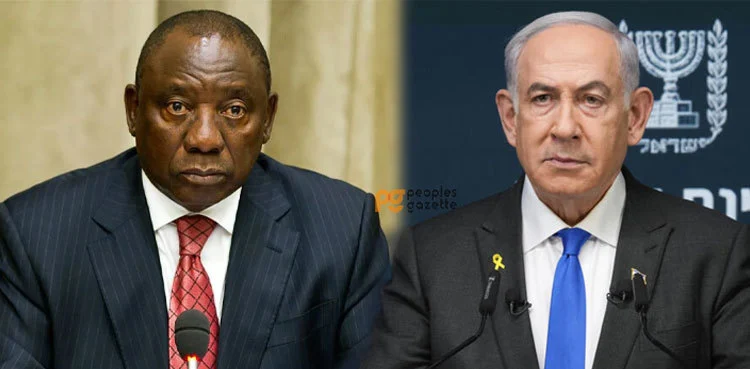
In a deterioration of relations, Israel and South Africa have expelled each other’s senior diplomats, marking the sharpest diplomatic rupture between the two countries since the end of apartheid and underscoring widening global divisions over Israel’s conduct in the Middle East.
In this imagined but plausible scenario, South Africa’s department of international relations and cooperation announced on Monday that Israel’s ambassador had been declared persona non grata and given 72 hours to leave the country. Hours later, Israel’s foreign ministry responded in kind, ordering the South African ambassador in Tel Aviv to depart, accusing Pretoria of “sustained hostility and political warfare masquerading as diplomacy”.
The tit-for-tat expulsions follow months of increasingly acrimonious exchanges, in which South Africa has positioned itself as one of Israel’s most outspoken critics on the international stage, while Israel has accused Pretoria of selective moral outrage and alignment with its adversaries.
South Africa’s foreign minister said the decision was taken after “repeated and serious breaches of diplomatic norms”, citing Israel’s rejection of international court rulings, its military campaign in Gaza, and what Pretoria describes as the “systematic dehumanisation of the Palestinian people”.
“South Africa cannot maintain normal diplomatic relations with a state that shows open contempt for international law,” the minister said in a statement. “Our own history obliges us to speak out when we see patterns of domination, dispossession and collective punishment.”
Israel’s response was swift and scathing. The foreign ministry accused South Africa of waging a “diplomatic crusade” against the Jewish state while ignoring conflicts elsewhere in Africa and beyond.
“This is not about human rights,” an Israeli official said. “It is about domestic political posturing and the cynical exploitation of our conflict for ideological gain.”
The breakdown did not come out of nowhere. Relations have been deteriorating steadily since South Africa recalled its ambassador for consultations during earlier phases of the Gaza war and openly supported legal action against Israel in international forums. Israeli officials, in turn, have accused South Africa of echoing the rhetoric of Hamas and other militant groups, a charge Pretoria strongly denies.
What distinguishes this episode is the symbolism. Diplomatic expulsions are rare between states that, while often at odds, have maintained channels of communication for decades. For South Africa, the move reinforces its self-image as a moral actor in global affairs, drawing explicit parallels between Palestinian suffering and its own experience under apartheid. For Israel, it signals growing frustration with what it sees as an increasingly hostile international environment, particularly among countries of the global south.
Analysts say the dispute reflects deeper shifts in global politics. “South Africa is asserting leadership among states that challenge the post-cold war Western consensus,” said one international relations scholar at a UK university. “Israel, meanwhile, is finding that its traditional alliances do not automatically translate into broader global support.”
The African National Congress, South Africa’s governing party, has long expressed solidarity with the Palestinians, rooted in historical ties between anti-apartheid activists and Palestinian movements. That stance plays well with parts of the domestic electorate, particularly ahead of tightly contested elections, critics say, though the government insists its policy is principled rather than populist.
Opposition parties within South Africa have been divided. Some have praised the expulsions as overdue, while others warn that cutting diplomatic ties limits Pretoria’s ability to act as a mediator and could harm trade and security cooperation.
In Israel, the episode has fed into an already polarised domestic debate. Rightwing politicians have seized on South Africa’s actions as evidence of international bias against Israel, while critics of the government argue that diplomatic isolation is the predictable result of an uncompromising foreign policy.
International reaction has been cautious. The UK foreign office said it was “concerned by the escalation” and urged both sides to keep communication channels open. The EU echoed calls for de-escalation, while some African and Latin American governments voiced support for South Africa’s stance, framing it as a defence of international law.
Whether the expulsions will lead to a complete severing of ties remains unclear. Both countries have stopped short of announcing a formal break in diplomatic relations, leaving room for lower-level engagement through embassies in third countries or multilateral forums.
Still, the damage is significant. Diplomats warn that rebuilding trust after such a public rupture will be difficult, particularly while the underlying issues – the Gaza war, the status of the Palestinians, and the credibility of international legal institutions – remain unresolved.
For now, the episode stands as a stark illustration of how a distant conflict can reverberate far beyond its immediate region, reshaping alliances and testing the limits of diplomacy. In choosing expulsion over engagement, Israel and South Africa have turned a long-simmering dispute into an open diplomatic war – one fought not with weapons, but with statements, symbolism and the weight of history.