
An internet blackout, widespread reports of rigging and intimidation and opposition arrests have clouded the elections.
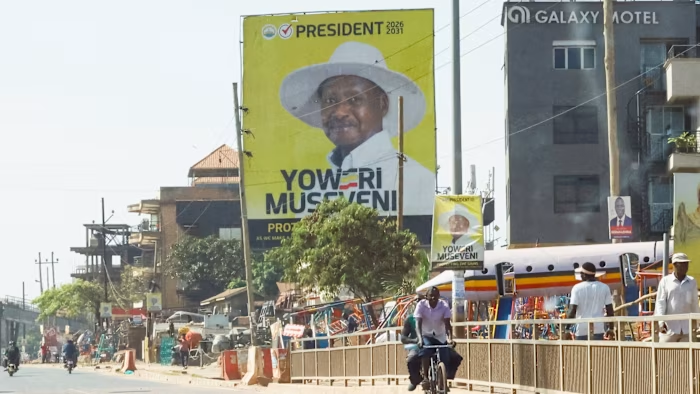
Uganda’s long-serving president, Yoweri Museveni, appeared on course on Friday to secure a seventh elected term, extending his rule towards four decades, as opposition figures, civil society groups and international observers raised serious concerns about the conduct of the election.
Partial results released by the electoral commission showed Museveni with more than 75% of the vote, based on tallies from over half of polling stations nationwide. His closest challenger, the opposition leader Bobi Wine, was credited with around 21%. Wine’s supporters rejected the figures, saying parallel vote counts compiled by his party suggested he was leading in several areas.
The vote took place under extraordinary conditions, including a nationwide internet blackout imposed on the eve of polling. The Uganda Communications Commission said the shutdown was intended to preserve public order and prevent the spread of misinformation. Opposition politicians and human rights groups said it severely curtailed transparency, hindered independent election monitoring and prevented voters from reporting irregularities in real time.
Despite the blackout, allegations of electoral malpractice quickly emerged. Activists used virtual private networks (VPNs), encrypted messaging platforms and peer-to-peer networks to circulate reports of ballot stuffing, harassment of polling agents and election observers, and the arrest or abduction of opposition activists.
Human rights organisations said the scale and consistency of the reports suggested systematic interference rather than isolated incidents. Some polling stations also experienced long delays, while others reported shortages of ballot papers and failures of biometric voter verification machines.
“The world needs to know what is happening in Uganda,” Wine wrote on X. “Internet switched off. Massive ballot stuffing reported everywhere. Our leaders arrested. Many of our polling agents and supervisors abducted, and others chased off polling stations.”
Wine, 43, whose real name is Robert Kyagulanyi, is a former pop star who has transformed himself into one of Museveni’s most formidable political challengers. His campaign, built around promises of democratic reform, job creation and an end to corruption, has resonated strongly with young Ugandans frustrated by unemployment and political repression.
Uganda has one of the youngest populations in the world, with more than three-quarters of citizens under the age of 25. Many have known no other leader than Museveni, who first took power in 1986 after leading a guerrilla war against a government he accused of stealing the 1980 elections.
Wine’s National Unity Platform (NUP) party said police and military personnel surrounded his home on Thursday night, “effectively placing him and his wife under house arrest”. The party said the move was intended to isolate him and prevent him from addressing supporters or challenging the official results.
Police denied the claim. A spokesperson told Deutsche Welle that Wine was not under house arrest and that security forces had been deployed for his own protection and to maintain order.
The government did not immediately respond to wider allegations of electoral abuses.
Museveni, now 81, has been a dominant figure in Ugandan politics for nearly four decades. He initially won praise at home and abroad for restoring relative stability after years of conflict and economic collapse, and later became a key western ally in east Africa, contributing troops to regional peacekeeping missions.
However, critics say his long rule has been marked by a steady erosion of civil liberties. Constitutional changes have removed presidential term limits and age limits, allowing him to remain in office indefinitely. Opposition figures have repeatedly complained of harassment, arbitrary arrests and violent crackdowns during election periods.
Museveni campaigned in this election on a platform of continuity and stability, using the slogan “protecting the gains”. His supporters argue that he remains the only leader capable of maintaining security and economic growth in a volatile region.
But the election took place against a backdrop of growing public discontent, particularly among young people hit hard by rising living costs, unemployment and corruption scandals. Wine’s rallies frequently drew large and enthusiastic crowds, despite repeated disruptions by security forces during the campaign.
Wesley Kambale, a Ugandan technology specialist, said he helped establish a public database to document alleged cases of vote rigging, intimidation and arrests during the blackout. Members of the Ugandan diaspora also played a key role in circulating images, videos and eyewitness accounts of election malpractice on social media platforms outside the country.
“No matter what happens today or tomorrow, we must resist,” Kambale said. “Our country, and its future, will not survive five more years of corruption, nepotism and human rights violations.”
The disputed vote has attracted international attention, coming amid a series of contested elections across Africa, including in Tanzania and Cameroon. Analysts say such polls highlight a growing disconnect between formal electoral processes and democratic accountability in several long-ruling states.
“It’s all well and good to criticise Africa’s military coups,” Tibor Nagy, a former US assistant secretary of state for Africa, wrote on social media. “But what if ‘elections’ are just as corrupt — Cameroon, Uganda etc — what can people do?”
Few observers expect Museveni to face significant external consequences. Uganda remains an important regional security partner for western governments, particularly in counterterrorism efforts in Somalia and the wider Horn of Africa.
An international law firm advising Wine said the internet shutdown amounted to a serious violation of international law and could expose Uganda to legal action and economic repercussions. In a statement, Amsterdam & Partners said the decision was “politically motivated, legally indefensible and designed to distort the electoral environment”.
“The decision by the government of Uganda to shut down internet access represents a grave breach of international law,” the firm said, warning of “institutional isolation and serious economic harm”.
As the count continues, opposition supporters fear the official results may simply formalise an outcome decided long before polling day. For many Ugandans, the election has deepened doubts about whether change through the ballot box remains possible under Museveni’s rule.