
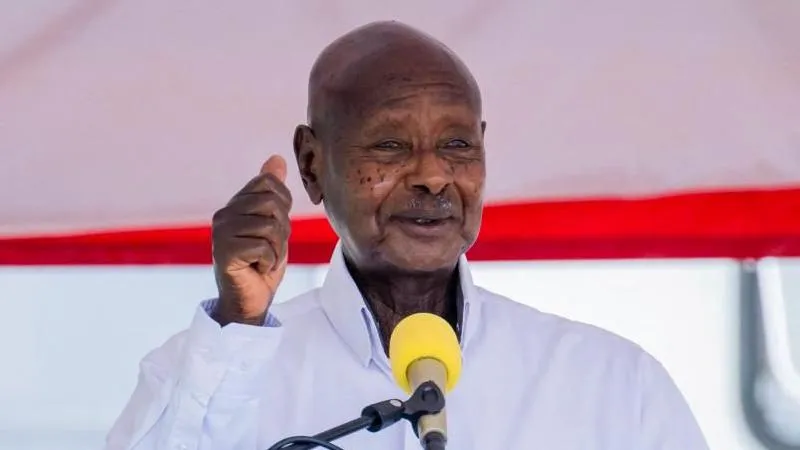
When Yoweri Kaguta Museveni first marched into Kampala in January 1986 at the head of his National Resistance Army, he was hailed across Africa and beyond as part of a new generation of leaders: disciplined, ideological and determined to break with the violent misrule that had scarred Uganda under Idi Amin and Milton Obote. Nearly four decades later, at the age of 76, Museveni has become one of the continent’s longest-serving presidents, his seventh electoral victory confirming both the durability of his rule and the deep contradictions at its heart.
Museveni’s leadership over the past 40 years can be divided into two broad phases. The first, stretching from the late 1980s into the early 2000s, was marked by relative consensus at home and admiration abroad. He restored a measure of security to a country ravaged by coups and civil war, rebuilt state institutions, and presided over a period of economic recovery underpinned by donor support. Uganda became a poster child for poverty reduction strategies and public health interventions, particularly in the fight against HIV/AIDS. Then in his forties and fifties, Museveni spoke the language of pan-Africanism and stability, positioning Uganda as a reliable regional actor and himself as a reformist statesman.
But the same period also laid the foundations for the political system that now defines his rule. The “no-party” or “movement” system, justified as a way of avoiding sectarian politics, concentrated power in the presidency and blurred the line between state and ruling movement. While elections were held, they were tightly managed, and dissent was tolerated only up to a point. Over time, constitutional safeguards gave way to political expediency: term limits were removed in 2005, and age limits in 2017, clearing the path for Museveni, now well into his seventies, to remain in office indefinitely.
The second phase of Museveni’s leadership has been characterised by increasing authoritarianism, generational tension and shrinking political space. Uganda today has one of the youngest populations in the world, most of whom have known no other leader. For many of them, the liberation narrative of 1986 holds little personal meaning. Instead, they face high unemployment, rising living costs and a political system that appears closed to meaningful change under a president old enough to be their grandfather.
It is in this context that Museveni’s re-election to a seventh term must be understood. According to official results, the 76-year-old secured 71.65% of the vote, a landslide that the government presents as a renewed mandate for continuity and stability. The opposition, however, paints a starkly different picture, alleging widespread intimidation, vote manipulation and the systematic abuse of state resources to entrench an ageing incumbent.
The election campaign and polling period were marred by familiar patterns. Opposition rallies were restricted or violently dispersed on the grounds of maintaining public order. Key challengers were arrested or placed under de facto house arrest. Independent media outlets faced pressure, while social media platforms were periodically blocked or throttled, limiting the ability of opposition figures to mobilise supporters, particularly young urban voters who represent the demographic future of the country.
On election day itself, reports emerged of logistical failures and technical “glitches”. Biometric voter verification kits reportedly failed in several areas, leading to delays or the exclusion of voters. In some constituencies, opposition agents were denied access to polling stations, undermining transparency. The electoral commission acknowledged some problems but insisted they were isolated and did not affect the overall outcome. For critics, these explanations rang hollow, reinforcing long-standing concerns about the independence of an institution overseeing yet another victory for a president in his eighth decade of life.
Allegations of rigging are not new in Museveni’s Uganda. Each successive election since the return to multiparty politics in 2006 has been followed by legal challenges, protests and, at times, lethal force by the security services. Courts have occasionally acknowledged irregularities but stopped short of annulling results, arguing that flaws did not substantially alter the outcome. This cycle has bred cynicism among voters and normalised the idea that elections are less about political choice than formal confirmation of an entrenched order.
The implications of Museveni’s latest re-election are therefore complex. In the short term, it ensures policy continuity and reassures regional allies who value Uganda’s role in peacekeeping and counter-terrorism efforts. Western governments, while expressing concern about human rights abuses and democratic backsliding, have often prioritised stability and security cooperation over direct confrontation with a veteran leader they have dealt with for decades.
Domestically, however, the costs of prolonged incumbency are mounting. The concentration of power around the presidency has weakened institutions, making succession an increasingly sensitive and potentially destabilising issue. Museveni’s reliance on the military and security apparatus to maintain order has blurred civilian–military boundaries, raising acute questions about what might happen when the 76-year-old president eventually leaves the scene.
For the opposition and civil society, the election underscores the limits of electoral politics under the current system. While new political movements and figures have energised young voters, their ability to translate popular support into power remains constrained by structural barriers and repression. This risks pushing dissent outside formal channels, with unpredictable and potentially volatile consequences.
Museveni’s supporters argue that his long tenure has provided Uganda with peace in a volatile region and that gradual reform, rather than abrupt change, is the safest path. His critics counter that stability without accountability is brittle, and that the erosion of democratic norms under an ageing presidency ultimately undermines the very security the regime claims to protect.
As Uganda enters yet another Museveni term, the question is no longer simply how long he can continue to win elections, but at what cost to the country’s political future. Forty years after he promised fundamental change, Uganda stands at a crossroads: caught between the legacy of a leader who once embodied hope, and the demands of a new generation seeking a voice in shaping its own destiny.