

When the Federal Government of Nigeria disbanded the infamous Special Anti-Robbery Squad in 2020 after nationwide demonstrations and global denunciation of torture, cruelty, and unlawful detention, the police leadership pledged a thorough metamorphosis. SWAT—the Special Weapons and Tactical Squad—was presented as the emblem of that renewal, a unit supposedly purged of the excesses that had made SARS a byword for dread. The authorities vowed a new ethos: professionalism, accountability, and reverence for constitutional rights. Yet the unfolding scandal in Enugu State now casts a sombre shadow over those assurances, for residents of Mburubu in Nkanu East LGA allege that the spectre of SARS has not been exorcised at all but has merely assumed a fresh appellation.
What began as a local chieftaincy dispute has degenerated into a tableau of fear, torment, and institutional disarray. In a decisive intervention on November 24, 2025, the High Court of Enugu State, presided over by Justice C. O. Ajah, issued an order restraining the Nigerian Police Force, the Inspector-General of Police, the Enugu State Commissioner of Police, and the SWAT unit from arresting or harassing ten applicants and more than seventy additional residents of Mburubu. The restraining order, sweeping in its scope, did more than shield the applicants: it effectively called into question the conduct of the very officers entrusted with upholding public order.
The dispute traces its origins to the 2003 Mburubu Town Union Constitution, which prescribes a rotational system for the Igweship among the six villages. According to that constitution, as affirmed by a High Court judgment, the throne should pass to Uhuegbe, the second-most senior village. The court consequently ruled that Mr. Patrick Onuokaibe, from Umunafor—the fifth in the hierarchy—was not eligible and was prohibited from presenting himself as Igwe or conducting any ceremonies in that capacity. Despite this clear injunction, residents contend that he defied the judgment by advertising a New Yam Festival online. A second restraining order was issued, but it was ignored.
Community members maintain that after the court forbade the festival, Onuokaibe still planned to proceed on the morning of November 1, 2025, despite security concerns raised by the Enugu State Commissioner of Police. As he prepared to flout the order, local youths began a peaceful protest but were confronted by DSS personnel guarding Onuokaibe. The officers allegedly opened fire, and a bullet struck one of the protesting youths. This escalated the situation, prompting the youths to barricade the roads. It took the intervention of the Enugu State Commissioner of Innovation, Science and Technology, Dr. Prince Lawrence Ezeh, along with a combined team of army and police officers, to appeal to the aggrieved youths and secure their peaceful dispersal. Later that night, Onuokaibe reportedly brought in unknown armed men who invaded the community and vandalized shops, but the youths repelled them.
It is at this point that allegations of police complicity arise. Onuokaibe is said to have enlisted the cooperation of SWAT officers, under the command of CSP Anosike Nduwuisi, to begin the intimidation, arrest, and torture of those he perceived as his opponents.
The accounts are disturbing. Several young men were reportedly seized without warrant, detained incommunicado, and subjected to sustained maltreatment. Families scoured police stations across Enugu, seeking word of the detained, only to discover that the youths were being held by SWAT. Their ordeal, as narrated by those who survived it, evokes harrowing memories of SARS’s notorious methods: clandestine detention, coercion, intimidation, and physical degradation.

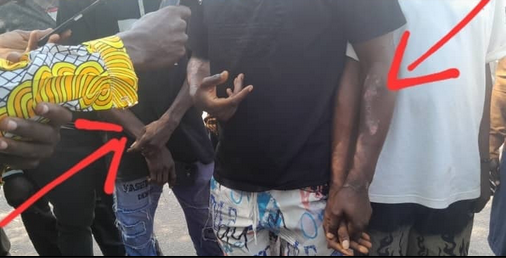
One of the victims, Eze Cletus Elija, recounted his experiences with a composure that thinly veiled the trauma beneath. He explained that he had approached a station to secure the release of another detained youth. Instead, he was summarily detained on the justification of an “order from above.” SWAT officers, whom he initially trusted and recognised by sight, allegedly handcuffed his hands behind him, bound his legs, and conveyed him to their office. What he described next is reminiscent of medieval torment: he was chained by his limbs, suspended in a contorted position, and left hanging for hours. He stated that he endured relentless beatings, accompanied by demands for confessions that he possessed firearms and was receiving sponsorship from Commissioner Prince Lawrence Eze.
According to Elija, the officers performed incantations, applied ritualistic substances to his skin, and issued macabre threats, asserting that they could kill him and dispose of his body without consequence. He recalled losing consciousness three times. His account, though uncorroborated in court at this stage, aligns closely with those of other detainees and with the type of brutality that the Nigerian public had believed consigned to the past with the end of SARS.
Another resident, Elder Ozo Emmanuel Aniobi, described the spectacle of humiliation that followed the youths’ release. The young men, he asserted, had been held for three weeks in dire conditions. When the officers allegedly learnt that a court application was imminent, they abruptly released the detainees—but not into the care of their families. Instead, Aniobi said they were taken directly from SWAT custody to the house of Onuokaibe and compelled to address him as Igwe. The action, if accurately reported, would not only contravene judicial orders but also expose a chilling entanglement between state power and personal ambition. Aniobi lamented that the gravest danger now facing the community is not the disqualified aspirant but the police officers who, in his view, have weaponised state authority to undermine lawful decrees.
A third victim, Elder Mr. Aniobi Ambrose, added yet another layer to the narrative of intimidation. He stated that he was ambushed by armed men loyal to Onuokaibe —men with guns and machetes who intercepted him on his way to a meeting. At first believing he was about to be kidnapped, he quickly realised that their purpose was to deliver him to the police. At the station, he encountered the tortured youths, their bodies bearing marks that moved him to tears. He said they were denied water, food, and any means of communication. Ambrose expressed disappointment in the state’s Commissioner for Chieftaincy Matters, Hon. Okey Ogbodo, whom he accused of behaving in a contradictory manner that eroded trust. He alleged that the commissioner’s vacillation appeared to aid those manipulating the crisis.
The cumulative weight of these accounts compelled the court to intervene. Justice Ajah, in his ruling, emphasised not only the immediate need to forestall further arrests but also the gravity of the claim that his earlier orders had been disregarded. He directed that the matter be brought to the attention of the State’s Chief Judge, noting that questions of contempt arising from a co-equal court must be addressed appropriately. This instruction, though procedural, underscores the gravity of the situation: a lower court cannot adjudicate contempt of another court of equal standing, but it can raise a flag when its orders appear to have been flouted.
The implication is clear. If the claims are substantiated, they would point to a profound institutional failure—one in which elements of the police have become enmeshed in a communal dispute, adopting methods at odds with the rule of law. The High Court’s restraining order has brought momentary relief, yet the apprehension in Mburubu remains palpable. Residents insist that only the unequivocal enforcement of judicial authority and a decisive intervention by the state government can restore tranquillity.
Beyond the immediate crisis, a broader and more unsettling question emerges. When SARS was abolished, Nigerians were told that the era of chains, fetishes, and secret cells had ended. SWAT was meant to embody reform, contrition, and renewal. But the allegations emanating from Enugu suggest continuity rather than rupture, as though the habits of the old unit have seeped, unpurged, into the new. If even a fraction of the claims are validated, they challenge the sincerity of the police reforms and raise the spectre of a security apparatus that has merely changed nomenclature, not nature.
Mburubu’s plight thus stands as a cautionary emblem of the nation’s unfulfilled aspirations for justice. A community governed peacefully for decades by a constitution crafted by its elders finds itself trapped between a defiant contender for the throne and officers wielding state authority in ways residents describe as arbitrary and vindictive. The victims’ appeals to Governor Peter Mbah underscore their conviction that the governor, known for his devotion to peace, may not yet appreciate the extent of the crisis or the potential for escalation if impunity persists.
For now, the restraining order remains the community’s sole bulwark. Whether it will be respected—or whether the shadow of SARS, under its new guise, will continue to loom over Enugu—depends on the resolve of the state, the vigilance of the judiciary, and the willingness of Nigeria’s security institutions to confront the ghosts they once promised to banish.