
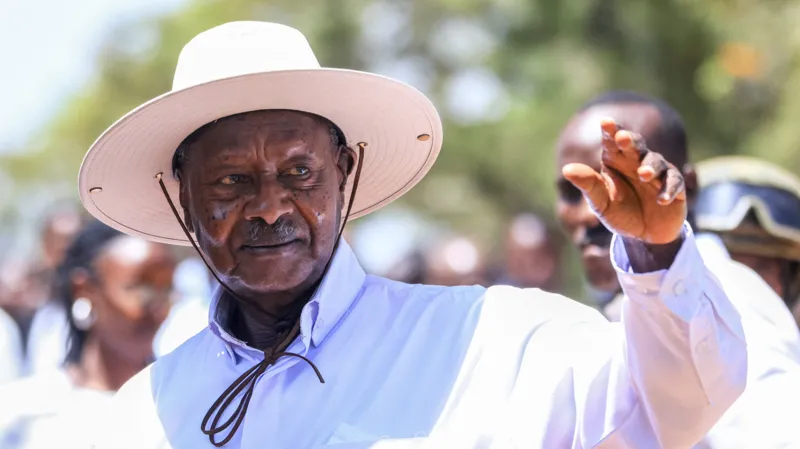
Uganda’s long-serving President Yoweri Museveni has secured a decisive victory in the country’s latest presidential election, winning a seventh term in office with 71.65 per cent of the vote, according to results announced by the Electoral Commission in Kampala. The outcome extends the rule of the 81-year-old leader, who first took power in 1986, to nearly four decades and cements his position as one of Africa’s longest-serving presidents.
The announcement, made on Saturday, confirmed that Mr Museveni comfortably defeated his main challenger, the opposition figure Robert Kyagulanyi, better known as Bobi Wine, a former pop star who has galvanised support among younger Ugandans. Mr Kyagulanyi was credited with just under a quarter of the vote, a result he and his supporters have rejected outright, alleging widespread fraud and intimidation.
The election was held amid tight security and a tense political atmosphere. In the days leading up to polling, authorities imposed restrictions on social media and internet access, citing the need to preserve public order and prevent the spread of misinformation. Opposition parties and civil society groups said the measures were designed to stifle dissent and limit scrutiny of the process, particularly in urban areas where support for Mr Kyagulanyi runs strongest.
Mr Museveni, who campaigned on a platform of stability, economic development and national security, hailed the result as a clear mandate from the Ugandan people. In a brief victory address, he thanked voters for their confidence and pledged to continue policies aimed at transforming the economy, expanding infrastructure and safeguarding the country from regional instability. His supporters argue that his long tenure has brought relative peace to a nation once riven by coups and civil conflict.
Yet critics say the election highlighted the narrowing space for political competition in Uganda. The campaign was marred by reports of heavy-handed policing, the disruption of opposition rallies and the arrest of activists. Mr Kyagulanyi claimed that security forces surrounded his home following the vote, effectively placing him under house arrest, a charge the authorities denied. He described the election as neither free nor fair and vowed to challenge the result through legal and peaceful means.
The president’s continued grip on power has been made possible in part by constitutional changes enacted during his rule. Term limits were removed in 2005, and a presidential age limit was scrapped in 2017, clearing the way for Mr Museveni to stand again despite his advancing years. While these changes were approved by parliament, opponents argue they undermined democratic safeguards and entrenched one-man rule.
International reaction has been cautious. Western governments and regional partners have acknowledged the result while urging restraint, respect for the rule of law and dialogue between the government and opposition. Uganda remains a key ally for many countries because of its role in regional security, including peacekeeping operations and efforts to stabilise neighbouring states such as South Sudan and the eastern Democratic Republic of Congo.
At home, the election has once again exposed a generational divide. More than three-quarters of Uganda’s population is under the age of 30, and many young people face unemployment and rising living costs. Mr Kyagulanyi’s campaign tapped into this frustration, portraying the vote as a choice between continuity and change. Although he fell well short of victory, analysts say his performance underscores the persistence of a restless opposition movement that is unlikely to disappear.
For Mr Museveni, the challenge now is to govern a country that is more politically polarised than at any point in his long rule. While his supporters praise his experience and emphasis on stability, critics warn that continued repression risks fuelling further unrest.