
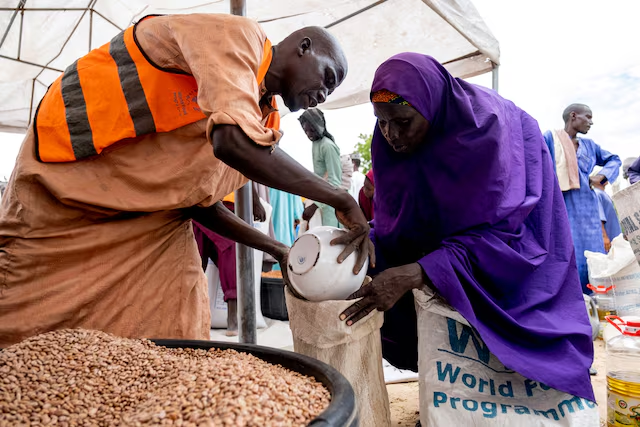
Nearly 35 million Nigerians are at risk of hunger this year, including around three million children facing severe malnutrition, the United Nations warned on Thursday, as a sharp collapse in global humanitarian funding forces deep cuts to life-saving aid in Africa’s most populous country.
Speaking at the launch of the UN’s 2026 humanitarian response plan in Abuja, the UN resident and humanitarian coordinator for Nigeria, Mohamed Malick Fall, said the country’s long-dominant, foreign-led aid model was no longer sustainable. Nigeria’s humanitarian needs, he said, had grown faster than the resources available to meet them.
“These are not statistics,” Fall told government officials, diplomats and aid workers. “These numbers represent lives, futures and Nigerians.”
The warning comes as Nigeria faces a convergence of crises driven by armed conflict, economic pressure, climate shocks and mass displacement. Rising food prices, flooding and prolonged insecurity have pushed millions into acute hunger, with conditions expected to worsen during the next lean season.
The situation is particularly severe in the conflict-affected northeast, where civilians in Borno, Adamawa and Yobe states continue to bear the brunt of violence linked to Islamist insurgency and criminal groups. Fall said insecurity had escalated sharply, with a surge in suicide bombings and widespread attacks. More than 4,000 people were killed in the first eight months of 2025 alone, a figure that matches the total number of deaths recorded during the whole of 2023.
Years of violence have displaced millions of people in the region, disrupting farming, markets and livelihoods. Many communities remain dependent on humanitarian assistance for food, clean water and basic healthcare, while access constraints and insecurity continue to hamper aid delivery.
Despite the growing needs, international support has fallen dramatically. Under the newly launched plan, the UN and its partners aim to mobilise $516m to provide emergency assistance to about 2.5 million people this year. That represents a steep reduction from the 3.6 million people targeted in 2025, which itself was roughly half the number assisted the previous year.
Fall said the UN had been forced to prioritise only the most critical interventions, focusing on activities that save lives rather than longer-term recovery and resilience. “We have no choice but to concentrate on the most lifesaving support,” he said, warning that many vulnerable people would be left without assistance.
Funding shortfalls have already had tangible consequences. Aid agencies have scaled back food distributions and nutrition programmes across several states, raising fears that millions could fall deeper into hunger. Late last year, the World Food Programme warned that dwindling resources would force it to cut support for hundreds of thousands of children, leaving many at heightened risk of acute malnutrition.
Health workers and aid officials say the reduction in nutrition services is particularly alarming for children under five, who are most vulnerable to wasting. Severe malnutrition in early childhood significantly increases the risk of death and can cause long-term physical and cognitive damage.
While stressing the severity of the crisis, Fall acknowledged what he described as growing national ownership of the humanitarian response. In recent months, Nigerian authorities have taken steps to fund lean-season food support, strengthen early-warning systems for flooding and improve coordination with aid agencies.
However, he cautioned that domestic efforts alone would not be enough to address the scale of the emergency. With a rapidly growing population and multiple, overlapping crises, Nigeria still requires sustained international support to prevent further deterioration.
Aid officials warn that the consequences of inaction could extend beyond humanitarian suffering, fuelling instability, displacement and long-term economic damage. As global aid budgets shrink, Nigeria’s crisis has become a stark example of the widening gap between humanitarian needs and the resources available to meet them.