
Confusion followed surprise United States air strikes in north-west Nigeria, as basic questions about the operation remained unanswered more than a month after the bombs fell. While both Washington and Abuja said the attacks targeted militants linked to Islamic State, they offered different explanations of what was hit, who was involved and why the strikes were launched when they were.
The lack of clarity has raised serious concerns inside Nigeria about national sovereignty, civilian safety and the real impact of the operation. Critics have also focused on the timing of the strikes after President Donald Trump said he delayed the attack so it could be launched on Christmas Day, a decision many Nigerians viewed as politically symbolic rather than militarily necessary.
The strikes took place overnight from Thursday 24th into Friday 25, December 2025 in Sokoto State, a remote region in Nigeria’s north-west. They marked one of the most direct American military actions inside the country in recent years and came without prior public notice from Nigerian authorities.
For several hours after the attack, it was unclear whether the strikes were carried out independently by the United States or as part of a joint operation. That uncertainty deepened when President Trump himself announced the attack before Nigerian officials made any formal statement.
Posting on social media late on Thursday night, Mr Trump said US forces had successfully struck Islamic State targets in Nigeria. His message quickly spread across Nigerian media, surprising opposition politicians and civil society groups, many of whom said they had learned of the operation from Washington rather than from their own government.
The president then added to the controversy in an interview with the US political website Politico. He said the strikes had been scheduled earlier than Thursday but that he personally intervened. “And I said, ‘nope, let’s give a Christmas present’,” he said, suggesting the timing was chosen for its symbolic value.
Those remarks provoked anger and unease in Nigeria. Critics said they reinforced fears that the country’s security challenges were being used for political messaging abroad, rather than addressed through careful coordination with Nigerian authorities.
Government officials in Abuja moved quickly to contain the fallout. Yusuf Tuggar, Nigeria’s foreign minister, insisted early on Friday that the operation was a joint one, carried out with the full approval of President Bola Tinubu. He said Nigeria had supplied intelligence and that the president had given final authorisation.
Mr Tuggar later told Arise News that he had been on the phone with US Secretary of State Marco Rubio shortly before the strikes. According to the minister, both sides agreed to issue a joint statement after the attack. However, he said Washington rushed out its own announcement first, creating confusion and diplomatic tension.
Opposition figures were not reassured. The People’s Democratic Party accused the government of allowing “foreign powers” to announce military operations on Nigerian soil before the country’s own authorities had spoken. The party said this undermined public trust and raised questions about sovereignty.
Activists echoed those concerns. Omoyele Sowore, a former presidential candidate and prominent campaigner, said that even twenty-four hours after the bombing, neither Nigeria nor its international partners had provided clear information. “Neither can provide clear, verifiable details about what was actually struck,” he said on Saturday.
Nigeria is facing one of the most complex security crises in Africa. In the north-east, it has battled Boko Haram and Islamic State West Africa Province for more than a decade. In the north-west, criminal gangs known locally as bandits carry out kidnappings, raids and mass killings. Some of these groups are said to have jihadist leanings, though the nature of their links remains disputed.
At first, the Nigerian government offered only broad descriptions of the targets. Mohammed Idris, the information minister, said the strikes targeted “ISIS elements attempting to penetrate Nigeria from the Sahel corridor”, referring to the unstable region stretching across Mali, Niger and Burkina Faso.
More detail emerged on Saturday. Daniel Bwala, a spokesman for President Tinubu, said the strikes targeted Islamic State militants who had entered Nigeria to work with the Lakurawa group, a jihadist organisation based mainly in Sokoto State, and with armed bandit gangs operating in the area.
“All three were targeted,” Mr Bwala said. He confirmed there were casualties but did not say how many people were killed or which groups they belonged to. No names were released, and no independent verification was offered.
The lack of specific information has frustrated analysts. Some security experts say the choice of Sokoto State itself raises questions. Nigeria’s jihadist violence has traditionally been concentrated in the north-east, far from the area hit by the strikes.
Recent research has suggested that some members of the Lakurawa group may have links to Islamic State Sahel Province. Other analysts strongly dispute this, arguing the group is primarily local and criminal rather than ideological. These disagreements have made it difficult to assess whether the strikes hit a clearly defined Islamic State cell.
Concerns deepened when reports emerged that civilian areas had been affected. Late on Friday, nearly a full day after the attack, Mr Idris said the strikes hit “two major Islamic State terrorist enclaves” in the Tangaza district of Sokoto State. He also admitted that debris from the strikes landed in nearby villages.
Photographs taken by an AFP photographer in Offa, in neighbouring Kwara State, showed damaged buildings, collapsed roofs and streets strewn with rubble and personal belongings. Residents described panic and confusion as explosions echoed through areas not previously associated with militant activity.
In Jabo town, also in Sokoto State, residents said the blasts came as a shock. “This surprised us because this area has never been a stronghold for armed groups,” said Haruna Kallah, a local resident. Officials did not confirm whether civilians were injured or killed.
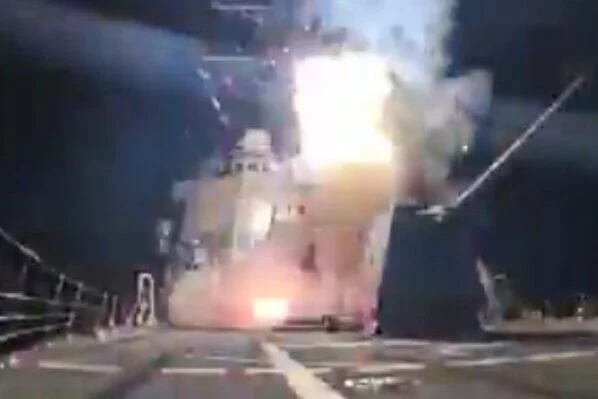
Uncertainty has also surrounded the weapons used. The US military released a video showing a navy ship launching what appeared to be missiles, suggesting the attack was launched from the sea. Mr Idris said the strikes came from “maritime platforms domiciled in the Gulf of Guinea”.
At the same time, he said that sixteen GPS-guided precision munitions were deployed using MQ-9 Reaper drones, which are usually launched from land bases. No explanation was offered for the apparent contradiction, and the US military declined to provide further technical details.
The strikes came against a backdrop of strained diplomatic relations. Earlier this year, President Trump described violence in Nigeria as “persecution” of Christians, a claim often promoted by religious groups in the United States. The Nigerian government and most independent analysts strongly reject that framing.
They argue that Nigeria’s violence is driven by poverty, criminal networks, weak governance and competition over land, rather than religion. Critics say portraying the conflict in religious terms risks inflaming tensions and misunderstanding the nature of the crisis.
Against that background, many Nigerians view the Christmas timing of the strikes, the lack of transparency and the public claims of credit by the US president as deeply troubling. Some commentators warned that the operation could strengthen extremist propaganda by portraying the Nigerian government as acting under foreign direction.
Despite the controversy, officials in both countries have said further strikes remain possible. They argue that cooperation with international partners is essential to prevent jihadist groups from spreading across borders and exploiting ungoverned spaces.
For now, however, many Nigerians remain unconvinced. Without clear information about who was killed, whether the intended targets were hit and whether civilians were harmed, public confidence continues to erode.
As one Abuja-based security analyst put it privately, if the strikes were meant to send a message, it remains unclear who that message was really meant to reach.