

The recent publication by Saharareporters circulating on various online platforms alleging that the Honourable Commissioner for Science and Technology, Dr. Prince Lawrence Ozoemena Ezeh, sponsored violence, armed youths, orchestrated attacks, and manipulated security agencies in Mburubu is yet another desperate attempt to distort the truth and mislead the public.
This is not the first time such fabrications have been churned out. They come from the same small group, driven by the same ambitions, telling the same lies in different forms. These narratives are consistently authored and orchestrated by Mr. Jerry Patrick Onuokaibe and circulated under names of individuals in vainglorious attempts to pull the Commissioner down. Their objective remains constant: to impose illegality on the peaceful community of Mburubu by manufacturing a false image of persecution.
Ordinarily, the Honourable Commissioner and the people of Mburubu would have ignored this publication, recognizing it as another recycled piece of propaganda. But because the publication is heavily laced with lies and concocted falsehoods capable of misinforming the public and darkening posterity, it has become necessary to set the record straight with verifiable facts.
The publication misrepresented critical historical facts, disregarded multiple court rulings, and attempted to rewrite the established constitutional order of Mburubu to suit the ambitions of one man—Mr. Jerry Patrick Onuokaibe—whose disqualification from the Igweship is already settled both traditionally and legally.
It is also necessary to clarify—contrary to the false impression deliberately created in the publication—that Dr. Prince Lawrence Ezeh is contesting for the Igweship stool. He never had, and will never have, any intention to occupy the throne. His late father, His Majesty Igwe E.M.O. Ezeh (Ozulumba I), had expressly instructed him that, based on the established rotational order of seniority, neither he nor any member of their royal household is permitted to contest for the throne when it is not the turn of Umudara. In strict obedience to this tradition, Dr. Ezeh declined to step into his father’s shoes after his demise in 2021, insisting that the rotation, customs, and constitution of Mburubu must be respected.
Furthermore, Dr. Ezeh is not imposing, endorsing, or sponsoring any candidate for the Igweship stool. His position remains the same: the throne must follow the constitutionally recognized rotational sequence without interference or manipulation.
Mburubu has a recognized, valid, government-approved constitution: the 2003 Mburubu Town Union Constitution. This document was drafted by a respected committee of elders, publicly read and unanimously adopted by all villages and branches during the general meeting of December 27, 2003. It was subsequently registered with the Enugu State Government on May 16, 2005, under registration number ENS/HDPR/TU/051. It is the only legitimate constitutional document governing the Igweship rotation, village seniority, town-union governance, and leadership succession. Yet the recent publication sought to downplay its authority, attempting to deceive the public into believing that Mburubu operates without structure or legal framework.
The truth is that both the 1976 and 2003 constitutions carry equal legal weight, as affirmed in the judgment delivered on February 12, 2025, by Hon. Justice C.O. Ajah, Ph.D. The court made it clear that neither constitution abolishes the principle that has guided Mburubu for decades: Igweship must rotate among the villages in their order of seniority. No lineage, no individual, and no village may unilaterally impose an Igwe outside the constitutionally recognized turn. The 1976 constitution already declared Igweship rotational. The 2003 constitution reinforced and expanded this principle. Therefore, anyone claiming a hereditary privilege or trying to jump the village queue is deliberately violating the law and traditions of the community.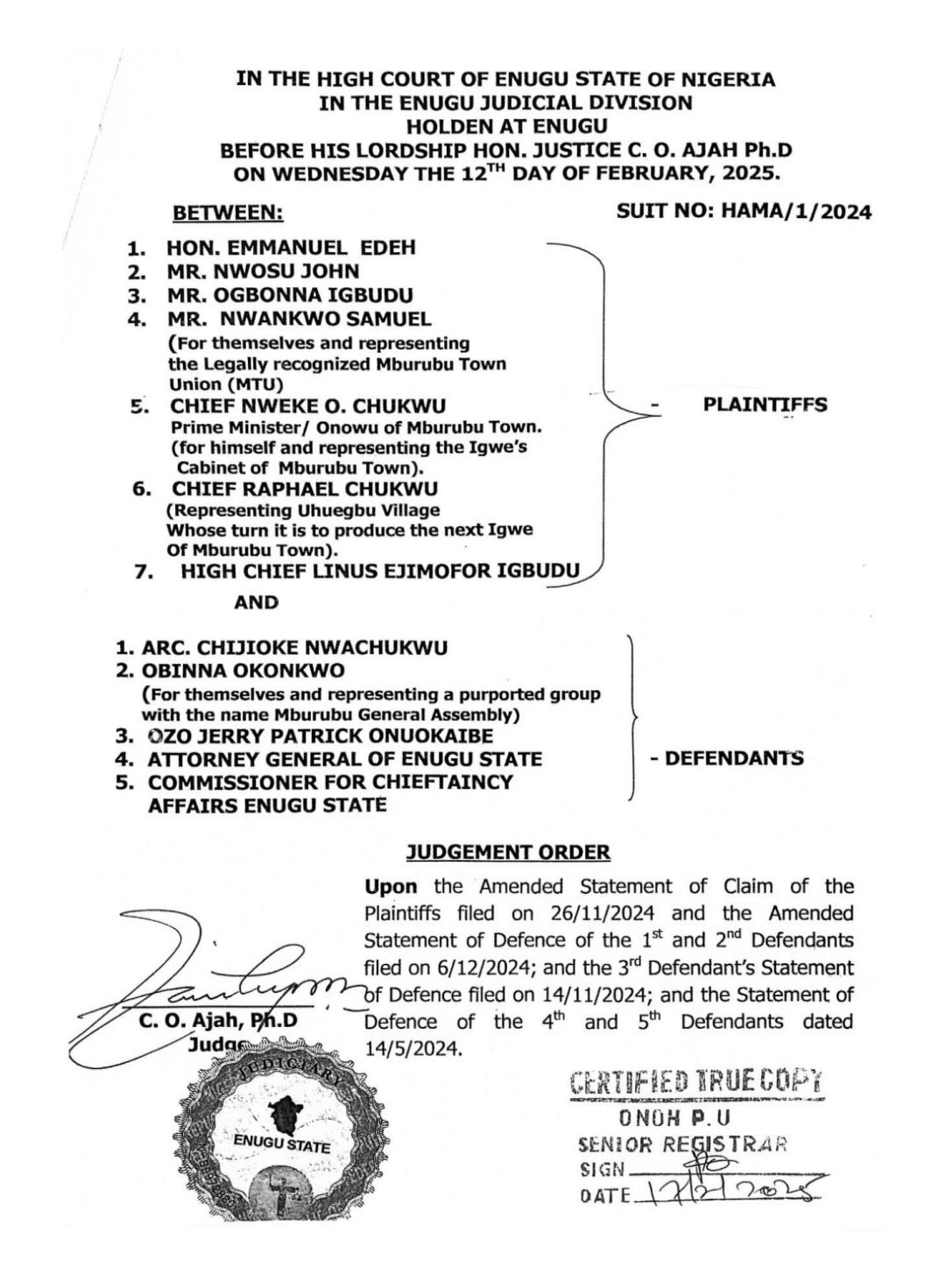


It is therefore both mischievous and dishonest for anyone to twist the narrative, ignore the role played by his own security personnel, and attempt to frame the Honourable Commissioner for a crisis triggered entirely by defiance of court orders and the reckless behaviour of those attached to Mr. Onuokaibe.
More disturbing still are the events that followed the shooting. Under Nigerian law, any case involving the unlawful use, discharge, or possession of a firearm is a state offence. Once reported, it becomes the exclusive domain of the State. The complainant has no authority whatsoever to interfere with suspects, influence their release, or take custody of them. Yet, in a shocking and deeply troubling development, Mr. Onuokaibe, despite being the petitioner and complainant, went to the police, secured the release (“bailed”) of the same individuals whose arrest he orchestrated, took them to his house, and coerced them to address him as “Igwe.” After extracting this forced endorsement, he gave each of them ₦10,000. This incident raises extremely serious questions. If he was truly a victim of a violent attack, why would he take custody of the alleged perpetrators? Why would he go to the police to bail suspects in a firearm-related case? Why were these individuals transported to his private residence rather than being processed in accordance with due legal procedures? Most importantly, why did he require them to proclaim him “Igwe” before giving them money? No reasonable person can interpret this other than as staged manipulation designed to fabricate legitimacy.
These acts confirm a troubling pattern: a process of manufacturing consent, coercing individuals, and using money and intimidation to create the illusion of support. The publication conveniently omitted these facts because they destroy the fragile narrative its authors attempted to construct.
The real issue in Mburubu is simple: the community must decide whether to uphold the constitution or allow one individual’s ambition to override the rule of law. The 2003 constitution remains clear. The courts have spoken. The community has spoken. Elders, youths, opinion leaders, and stakeholders have all affirmed that the constitutional order must stand. Prince Lawrence Ezeh and the majority of peace-loving indigenes believe in following the law. Mr Onuokaibe and his co-merchants of lies and mischief makers believe in violating it.
Every attempt to drag the name of the Honourable Commissioner into the mud is nothing but a political strategy to blackmail him into silence. The goal is to weaken institutional resistance so that an unqualified candidate can be imposed on the community. This will not happen. The people of Mburubu have come too far and sacrificed too much to allow the constitution to be shredded for the sake of one man’s ambition.
The truth remains that the Honourable Commissioner did not arm youths. He did not sponsor violence. He did not orchestrate attacks. He did not manipulate the DSS or the police. These allegations exist only in the imagination of those who authored them. What he has consistently championed is peace, constitutionality, and respect for judicial authority. The crisis stemmed solely from the reckless defiance of court orders and the failure of one man to accept that he is not eligible to be Igwe.
The public is therefore advised to disregard the misleading publication and rely on the verifiable facts already affirmed by the courts and the constitution of Mburubu. Propaganda will fade. The law will stand. No degree of falsehood, emotional blackmail, or media manipulation can change the undisputed truth that it is not the turn of Umunafor village and that Mr. Jerry Patrick Onuokaibe is not qualified to become Igwe of Mburubu.
By Dr. Chidipeters Okorie
Personal Media Aide to
Dr. Prince Lawrence Ozoemena Ezeh
The Prince of Mburubu Kingdom