


Al-Husseina Amadou never forgets the day she was sold. Like her parents, she was born into slavery in southern Niger. Forty-five years ago, when she was 15, a wealthy businessman from across the border in Nigeria arrived and bought her from her family’s master as a “fifth wife” or wahaya.
“My parents had no say,” she recalls. “I was just a girl and he bought me like a chicken in the market. When I left with him, I was crying with my mother.”
For 15 years Amadou lived with her “husband” in northern Nigeria, cooking and cleaning for his four “official” wives, whom he had married in accordance with Islamic law, and their children, while also working in their fields and tending their livestock.
Barely fed, she would eat the family’s leftovers or steal handfuls of grain. She ran away dozens of times, returning to her family in Niger, but was always caught and brought back.

For these transgressions she was beaten with a stick and still carries the scars on her back.
“If I fled or didn’t work, the wives and even the children would beat me,” Amadou says. “It was a pitiful situation. I was skinny because I was always hungry. If my husband bought food he would just give it to his wives and children. I got nothing.”
Eventually Amadou escaped by joining a caravan of camel herders that took her across the border back into Niger in a gruelling journey that took seven days on foot. There she was found by activists from Timidria, a local charity that campaigns against slavery.
“Whenever I remember that journey, I cry,” she says. “I didn’t even have shoes.”
Slavery has a complex legacy in Niger. It was pervasive in west African kingdoms centuries ago but despite several attempts at abolition, it remains deeply entrenched.
The French colonial administration outlawed slavery in 1905 and it was also banned under the 1960 constitution, when Niger gained independence. Other attempts followed in 1999 and 2003, with a penal code that formally defined and criminalised the practice.
Yet there are still tens of thousands of enslaved people across Niger, according to Anti-Slavery International and Timidria; some estimates put the number as high as 130,000. Most are descendants of people who were enslaved generations ago, living and working on the land of their ancestral “masters”, similar to serfs in Tsarist Russia.
Wahaya is one of the most prevalent forms of bondage in Niger. It is a system through which wealthy men and traditional leaders buy girls for sex and domestic work for as little as £200.
Today wahaya is mainly practised in a southern region near the Nigerian border Timidria refers to as the “triangle of shame”. The tradition allows men who have the maximum of four wives permitted by Islamic law to take on concubines known euphemistically as “fifth wives”.
“It is a form of sex trafficking,” says Dr Benedetta Rossi, who studies slavery in Niger at University College London. “In Islam, prostitution and sex outside of marriage are outlawed as sins, and so there is a demand for women who are available for a relationship that certain groups consider legitimate from a traditional and a religious-legal perspective.”
The children of women enslaved as wahaya are born with free status. “You can be a man of 70 with four wives and a wahaya, who continues to produce sons and daughters,” says Rossi. “It adds to your status. You are not just having sex, you are producing heirs.
“You are also producing free labour because the wahaya is constantly working – she fetches water, she cleans, she cooks, she does jobs free wives cannot do because they are supposed to stay at home.”
Men with wahaya are often well connected and police turn a blind eye to the practice, at times punishing the women who protest against their status rather than the men who enslaved them, according to Ali Bissou, the head of Timidria.
“There was a case in 2021 when a wahaya rebelled against her husband’s official wife and the police refused to intervene; they didn’t care,” says Bissou at his office in Niamey, Niger’s capital. “We had to explain the situation to the police – that wahaya is illegal. There are even many judges who are not aware of this.”
Founded in 1991, Timidria has offices in every region of Niger and relies on a network of volunteers to identify victims of slavery. It also visits villages, informing enslaved people of their rights and helping them bring lawsuits against their enslavers. It has set up several centres for former slaves and their children.
These efforts have met stiff resistance. The organisation has been accused of fraud and terrorism, and several of its staff have spent time behind bars.
“There is very little change,” says Bissou. “Even today, if you visit the house of a chief in the ‘triangle of shame’, you will find wahayas, for sure. The best thing we can do is keep raising awareness that this is illegal.”
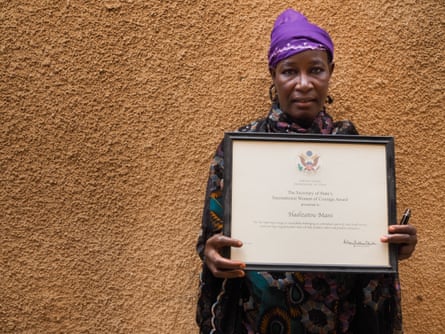
Hadizatou Mani is one of the former wahaya Timidria has assisted. In 1996, aged 12, she was sold for about £250 to a man in his sixties, who beat her and forced her to bear three children.
“I was brought to my new husband’s compound at night,” says Mani. “I had to pound millet, fetch water and work on his farm during the planting season and the harvest. I didn’t have the right to say no. There was no choice but to obey.”
She adds: “When I was with him, he beat me often. The neighbours asked him to stop but he refused. He said he owned me and could do whatever he wanted to do.”
In 2005, two years after Niger’s new penal code criminalised slavery, Mani was granted a certificate of freedom and released by the man after 10 years of servitude.
But when she married as a free woman, her former master filed a legal complaint against her, claiming she was his wife and accusing her of bigamy.
The judge overseeing the case ruled in favour of the man and sentenced Mani to six months in prison. “It was incredible,” she says. “I was kept in a crowded cell like a criminal. Even the guards apologised, but they said they were doing what they had to do.”
With the help of Timidria and Anti-Slavery International, in 2008 Hadizatou took her case to the court of justice of the Economic Community of West Africa State (ECOWAS). The court made a landmark judgment against the Nigerien state, which it ruled had broken its own anti-slavery laws and awarded Mani $20,000 compensation.
A year later, in 2009, Hadizatou received the US state department’s International Women of Courage Award at a ceremony in Washington with Hillary Clinton and Michelle Obama. In 2019, Niger’s Supreme Court finally overturned Mani’s bigamy conviction and directly banned wahaya.
“I was so proud, so happy, because it meant that many women will benefit, not just me,” says Mani. “Before I didn’t have any rights; I could not say what I wanted. But since then I can work, I can help myself and other people.”
Unlike Mani, Amadou chose not to marry as a free woman. Today she lives with five other former wahaya and their children. Together they run a co-operative, weaving straw sleeping mats and selling them at their local market.
“We were treated like animals,” says Amadou. “Now we are free; we live like people. No one tells us what to do. We have a happy life.”


Discussion about this post