Saturday, January 10, 2026
  • Who’sWho Africa AWARDS
  • About TimeAfrica Magazine
  • Contact Us
Time Africa Magazine
  • Home
  • Magazine
  • WHO’SWHO AWARDS
  • News
  • World News
    • US
    • UAE
    • Europe
    • UK
    • Israel-Hamas
    • Russia-Ukraine
  • Politics
  • Crime
  • Lifestyle
  • Sports
  • Column
  • Interviews
  • Special Report
No Result
View All Result
Time Africa Magazine
  • Home
  • Magazine
  • WHO’SWHO AWARDS
  • News
  • World News
    • US
    • UAE
    • Europe
    • UK
    • Israel-Hamas
    • Russia-Ukraine
  • Politics
  • Crime
  • Lifestyle
  • Sports
  • Column
  • Interviews
  • Special Report
No Result
View All Result
Time Africa Magazine
No Result
View All Result
  • Home
  • WHO’SWHO AWARDS
  • News
  • Magazine
  • World News

Home » Special Report » Sudan’s civil war: how did it begin, what is the human cost, and what is happening now?

Sudan’s civil war: how did it begin, what is the human cost, and what is happening now?

Conflict that pits army against paramilitary group has killed tens of thousands and caused hunger, disease and displacement

October 23, 2024
in Special Report
0
Sudanese armed forces in Omdurman in March. The following month, they advanced into the city for the first time since war with the RSF started in April 2023. Photograph: El Tayeb Siddig/Reuters

Sudanese armed forces in Omdurman in March. The following month, they advanced into the city for the first time since war with the RSF started in April 2023. Photograph: El Tayeb Siddig/Reuters

558
SHARES
4.7k
VIEWS
Share on FacebookShare on Twitter

How did the conflict begin?

Fighting broke out in Khartoum, Sudan’s capital, on 15 April 2023 as an escalating power struggle between the two main factions of the military regime finally turned deadly.

On one side are the Sudanese armed forces who remain broadly loyal to Gen Abdel Fattah al-Burhan, the country’s de facto ruler. Against him are the paramilitaries of the Rapid Support Forces (RSF), a collection of militia who follow the former warlord Gen Mohamed Hamdan Dagalo, known as Hemedti.

The RSF was founded by the former dictatorial ruler Omar al-Bashir as an Arab counterinsurgency militia. Bashir wanted to crush a rebellion in the region of Darfur that began more than 20 years ago due to the political and economic marginalisation of the local population.
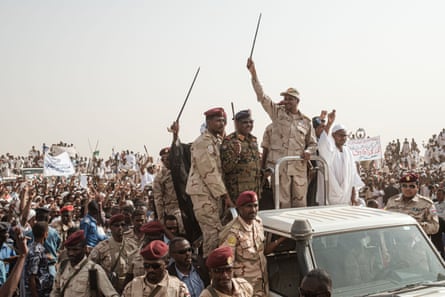
Gen Mohamed Hamdan Dagalo (Hemedti) salutes the crowd from the back of a truck at a military rally
Gen Mohamed Hamdan Dagalo, known as Hemedti, at a rally in Abraq village, outside Khartoum, in June 2019. Photograph: Yasuyoshi Chiba/AFP/Getty Images

Initially known as the Janjaweed, the RSF quickly became synonymous with widespread atrocities. In 2013, Bashir transformed the group into a semi-organised paramilitary force and gave its leaders military ranks before deploying it to crush a fresh rebellion in South Darfur.

ReadAlso

British company breeding genetically engineered mosquitoes in Africa

The Crimes No One Reports: Sexual Violence in Mali’s Shadow War

Hemedti’s power struggle with Burhan can be traced back to 2019 when the RSF and regular military forces cooperated to oust Bashir from power. When attempts to transition to a democratic civilian-led government faltered, many analysts felt an eventual showdown between Burhan and Hemedti was inevitable.

What has been the human cost?

The conflict has plunged Sudan into what the UN has described as “one of the worst humanitarian nightmares in recent history”. Tens of thousands have died, millions have been displaced, and hunger and disease are rife.

ADVERTISEMENT

According to the most recent figures, about 26 million people face severe food insecurity. Famine has been declared in the Zamzam displacement camp in Darfur.

About 11.3 million people have been forced to flee the fighting, including nearly 2.95 million who have fled across the country’s borders. Most have gone to Chad and South Sudan, where underfunded aid agencies say they are struggling to meet basic needs. A UN appeal for $1.51bn to support Sudanese refugees and their hosts in the region through the end of the year remains just 27% funded.
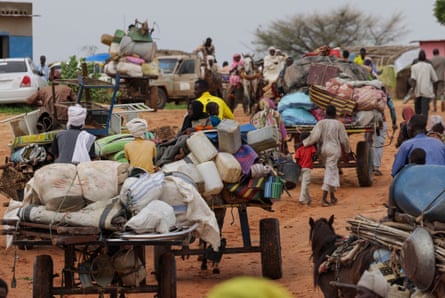
Sudanese people walk beside horse-drawn carts piled high with belongings at the Sudanese border with Chad
Displaced Sudanese people cross the border into Chad on 4 August 2023, where millions are already facing acute food insecurity. Photograph: Zohra Bensemra/Reuters

In its latest humanitarian update, published on 1 October, the UN’s Office for the Coordination of Humanitarian Affairs said significant declines in vaccination rates and the destruction of health infrastructure resulting from the war mean Sudan is grappling with multiple disease outbreaks, including cholera, malaria, dengue fever, measles, and rubella. An estimated 3.4 million children under the age of five are at high risk of epidemic diseases, according to Unicef.

The conflict has also robbed huge numbers of an education. More than 90% of the country’s 19 million school-age children are unable to access formal education. Schools have been targeted in airstrikes, occupied by armed groups and used to store weapons.

What atrocities are the warring sides accused of?

The UN has accused the army and the RSF of carrying out indiscriminate attacks in residential areas, committing acts of sexual violence, arbitrarily detaining and torturing civilians and recruiting child soldiers. Both parties may have committed war crimes, a UN report in February said. They have denied the claims.

The US went a step further last year, declaring that both had carried out war crimes and that the RSF had committed crimes against humanity and ethnic cleansing.

Some of the war’s worst atrocities have been committed in Darfur, western Sudan. As many as 15,000 people were killed in the city of El Geneina in West Darfur last year by the RSF and allied Arab militias in violence targeted at the Masalit people. The US secretary of state, Antony Blinken, said the violence carried “haunting echoes of the genocide that began almost 20 years ago”.

In June, pro-democracy activists said the RSF killed more than 100 people in an attack on a village in central Sudan.
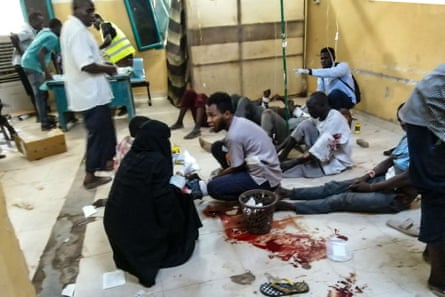
Wounded people lie and sit on a blood-spattered floor in a medical centre
Wounded people are treated at Bashayer hospital in northern Khartoum in June 2023. Photograph: AFP/Getty Images

What is the current status of the war?

In recent weeks, the RSF has launched a full-scale attack on El Fasher, the only major population centre in Darfur it is yet to control. The attack follows a months-long siege. The city’s last hospital was forced to close after the paramilitary group stormed it in June. The RSF is also advancing in regions south of Khartoum.

In the capital, which fell to the RSF early on in the war, the armed forces have gone on the offensive, pounding the centre and south of the city from the air this month.

Several rounds of negotiation efforts have so far failed to end the fighting.

Why is Darfur at the centre of the conflict?

Home to about 9 million people, Darfur, the vast and largely arid swath of western and south-western Sudan, has been at the centre of the conflict largely because it remains the stronghold of Hemedti. Many of the RSF’s recruits are drawn from the region and from Hemedti’s own Rizeigat tribe.

For years, the RSF has terrorised communities in Darfur and much of the region is lawless: militias and other armed groups attack civilians with virtual impunity. In recent years, the RSF has invested significant resources in Darfur in an attempt to control its strategic assets, such as airstrips, mines, water sources and major roads. Analysts trace many of the roots of the latest conflict back to the appalling violence and human rights abuses in Darfur about 20 years ago.

Source: The Guardian
Tags: AfricaChadConflict And ArmsDarfurMiddle East and North Africasudan
ADVERTISEMENT
Previous Post

Despair in Chad camps as violence and hunger in Sudan drive 25,000 across border in a week

Next Post

EFCC Docks Fake Fertility Nurse for Alleged N28.2m Fraud in Enugu

You MayAlso Like

Special Report

Nigeria’s Benue state faces fallout from US-backed airstrikes

January 10, 2026
Special Report

Africa May Grow Faster Than Asia for the First Time, But Big Challenges Remain

January 9, 2026
Special Report

United States Resumes ISR Flights Over Nigeria After Sokoto Airstrikes

December 28, 2025
Special Report

Study Confirms ISWAP Logistics Hub in Sokoto as Questions Trail Focus of US Air Strikes

December 27, 2025
Special Report

U.S. Strikes ISIS in Nigeria After Trump Warned of Attacks on Christians

December 26, 2025
Special Report

U.S. launches Christmas Day strikes on ISIS targets in Nigeria

December 26, 2025
Next Post

EFCC Docks Fake Fertility Nurse for Alleged N28.2m Fraud in Enugu

The Commonwealth is more relevant today than it has been in decades

Discussion about this post

Trump: I don’t need international law – only one thing limits my power

Nyash, Abeg, Biko, Amala, Other Nigerian Words Added to the Oxford Dictionary

Nigeria’s Benue state faces fallout from US-backed airstrikes

Trump Says U.S. Oversight of Venezuela Could Last for Years

Pope raises alarm over human rights and a spreading “zeal for war”

Trump signals possible follow-up air strikes in Nigeria

  • Trump: I don’t need international law – only one thing limits my power

    543 shares
    Share 217 Tweet 136
  • Nyash, Abeg, Biko, Amala, Other Nigerian Words Added to the Oxford Dictionary

    543 shares
    Share 217 Tweet 136
  • Nigeria’s Benue state faces fallout from US-backed airstrikes

    542 shares
    Share 217 Tweet 136
  • Trump Says U.S. Oversight of Venezuela Could Last for Years

    542 shares
    Share 217 Tweet 136
  • Pope raises alarm over human rights and a spreading “zeal for war”

    542 shares
    Share 217 Tweet 136
  • Trending
  • Comments
  • Latest

Trump: I don’t need international law – only one thing limits my power

January 10, 2026

Nyash, Abeg, Biko, Amala, Other Nigerian Words Added to the Oxford Dictionary

January 9, 2026

Nigeria’s Benue state faces fallout from US-backed airstrikes

January 10, 2026

Trump Says U.S. Oversight of Venezuela Could Last for Years

January 9, 2026

Pope raises alarm over human rights and a spreading “zeal for war”

January 10, 2026

Trump: I don’t need international law – only one thing limits my power

January 10, 2026

Nigeria’s Benue state faces fallout from US-backed airstrikes

January 10, 2026

Nyash, Abeg, Biko, Amala, Other Nigerian Words Added to the Oxford Dictionary

January 9, 2026

ABOUT US

Time Africa Magazine

TIMEAFRICA MAGAZINE is an African Magazine with a culture of excellence; a magazine without peer. Nearly a third of its readers hold advanced degrees and include novelists, … READ MORE >>

SECTIONS

  • Aviation
  • Column
  • Crime
  • Europe
  • Featured
  • Gallery
  • Health
  • Interviews
  • Israel-Hamas
  • Lifestyle
  • Magazine
  • Middle-East
  • News
  • Politics
  • Press Release
  • Russia-Ukraine
  • Science
  • Special Report
  • Sports
  • TV/Radio
  • UAE
  • UK
  • US
  • World News

Useful Links

  • AllAfrica
  • Channel Africa
  • El Khabar
  • The Guardian
  • Cairo Live
  • Le Republicain
  • Magazine: 9771144975608
  • Subscribe to TIMEAFRICA MAGAZINE biweekly news magazine

    Enjoy handpicked stories from around African continent,
    delivered anywhere in the world

    Subscribe

    • About TimeAfrica Magazine
    • Privacy Policy
    • Contact Us
    • WHO’SWHO AWARDS

    © Copyright TimeAfrica Magazine Limited 2026 - All rights reserved.

    No Result
    View All Result
    • WHO’SWHO AWARDS
    • Politics
    • Column
    • Interviews
    • Gallery
    • Lifestyle
    • Special Report
    • Sports
    • TV/Radio
    • Aviation
    • Health
    • Science
    • World News

    © Copyright TimeAfrica Magazine Limited 2026 - All rights reserved.

    This website uses cookies. By continuing to use this website you are giving consent to cookies being used. Visit our Privacy and Cookie Policy.